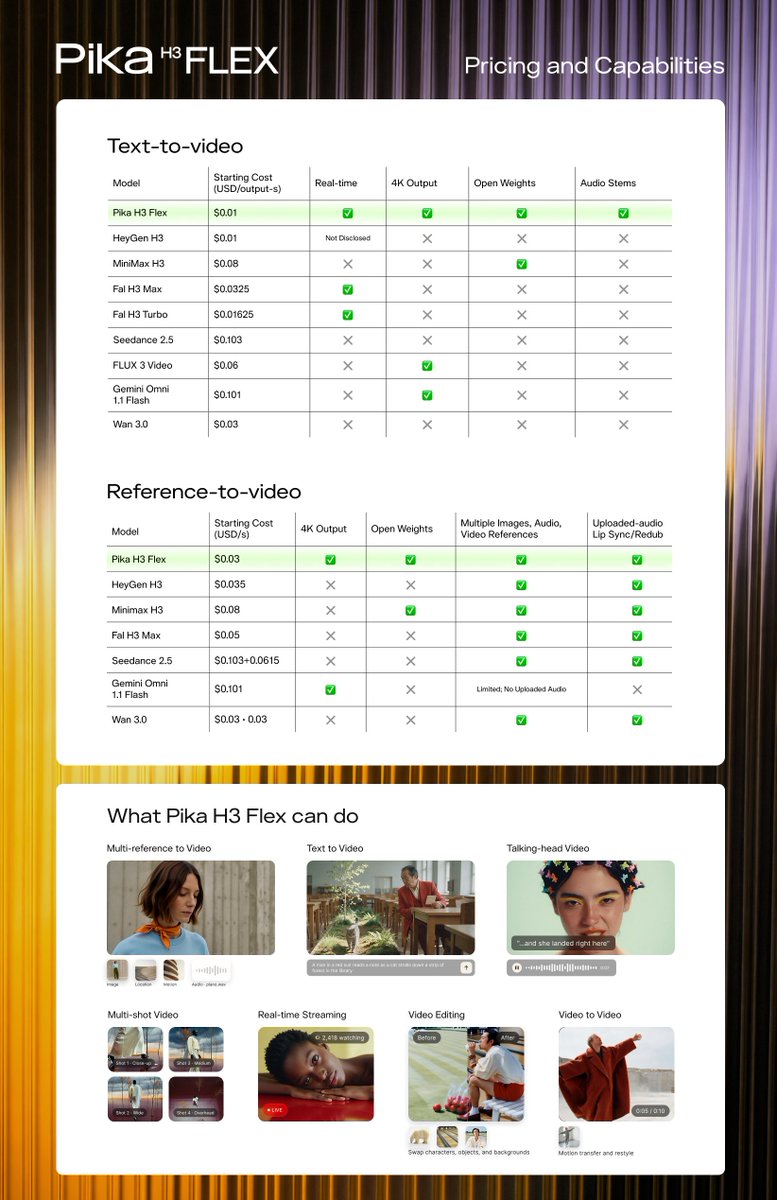
Pika H3 Flex is an open-weights AI video model that generates faster than realtime, from 0.01 a second
Pika says H3 Flex makes video in six denoising steps instead of 50, ships with open weights and starts at 0.01 a second. Here is what that could change for AI filmmakers, and what to check first.
Pika has released a video model that generates faster than you can watch it, and the weights are open. For anyone who has sat through a render queue to find out a shot was wrong, that is the headline. Pika H3 Flex starts at 0.01 a second, which makes trying ten versions of a shot a small decision instead of a budget meeting.
The company's own deep dive, posted by @pika_labs, explains how it got there. Pika post-trained the model to generate in six denoising steps instead of 50, then refined it for quality and creative control. Fewer steps is the whole trick. It is why the model can run faster than realtime, and it is why the price can sit so low. A few days after launch, the same account pointed to a creator montage where every cut came from a single 15-second generation, which is the multi-shot behaviour filmmakers will care about most.
What it changes in a real workflow
Speed changes how you work before quality does. At realtime or better, a model stops being something you submit jobs to and becomes something you iterate with. You can try a camera move, see it, nudge the prompt and try again inside a minute. That suits blocking, animatics, pitch reels and any stage where you are hunting for the shot, not polishing it.
Multi-shot from one generation matters for a second reason. Anyone who has stitched a sequence from separate clips knows the pain of keeping a character, a costume and a light setup consistent across cuts. If H3 Flex can hold a scene together across a 15-second run with several cuts, that removes a chunk of the conform work. One clip is not proof it does so reliably, so treat that montage as a reason to test, not as a benchmark.
How it sits against the alternatives
The current routine for most AI filmmakers is a premium closed model for hero shots and something cheaper for everything else. H3 Flex is clearly aiming at that second slot, and the open weights add something closed rivals cannot offer. You can in principle run it on your own hardware, build it into your own pipeline and keep client material off third-party servers. That last point is a real selling point for anyone working under NDA.
For hero shots, though, nothing in Pika's posts claims H3 Flex beats the top closed models on fidelity. The word Pika uses is Flex, and the pitch is speed, control and cost. Read it that way.
What was not said
The posts do not give a maximum resolution, a maximum clip length beyond the 15-second example, or whether audio is generated. They do not state the licence terms for the open weights, which decides whether you can use the model on paid client work. The price is quoted as 0.01 a second, and the posts do not spell out the currency or whether that rate applies to every resolution and mode. There is no independent benchmark either. The only quality evidence so far is Pika's own showcase.
The hardware needed to run the weights locally has also not been stated. Faster than realtime on Pika's infrastructure does not mean the same on a single consumer GPU.
What to test first
Start with the claim that matters most to you. Generate the same three prompts at several seeds and see how much of the 15-second multi-shot behaviour holds up when your own character and location are involved. Then check motion on hands, faces and fast camera moves, which is where cheap fast models usually give way. Finally, read the licence before you put a single frame into client work.
At 0.01 a second, a full minute of footage costs 0.60 at the quoted rate, so the experiment is cheap enough to run properly. If the quality holds for previs and social work, H3 Flex becomes the model you reach for first and the expensive one you save for the final frames.
Source: Pika's technical deep dive on H3 Flex (post) and Pika's creator showcase featuring the 15-second multi-shot montage (post).