Higgsfield is making the first movie driven entirely by GPT-6 Astra computer-use, and the demo reel it posted this week shows what that actually means
Over two days Higgsfield published more than 30 demos of GPT-6 Astra operating Blender, Premiere Pro, DaVinci Resolve, After Effects, Houdini, Cinema 4D, Photoshop, Krita, Procreate, TouchDesigner and Figma autonomously through its platform. The headline claim: a full feature film made without a human touching the controls.
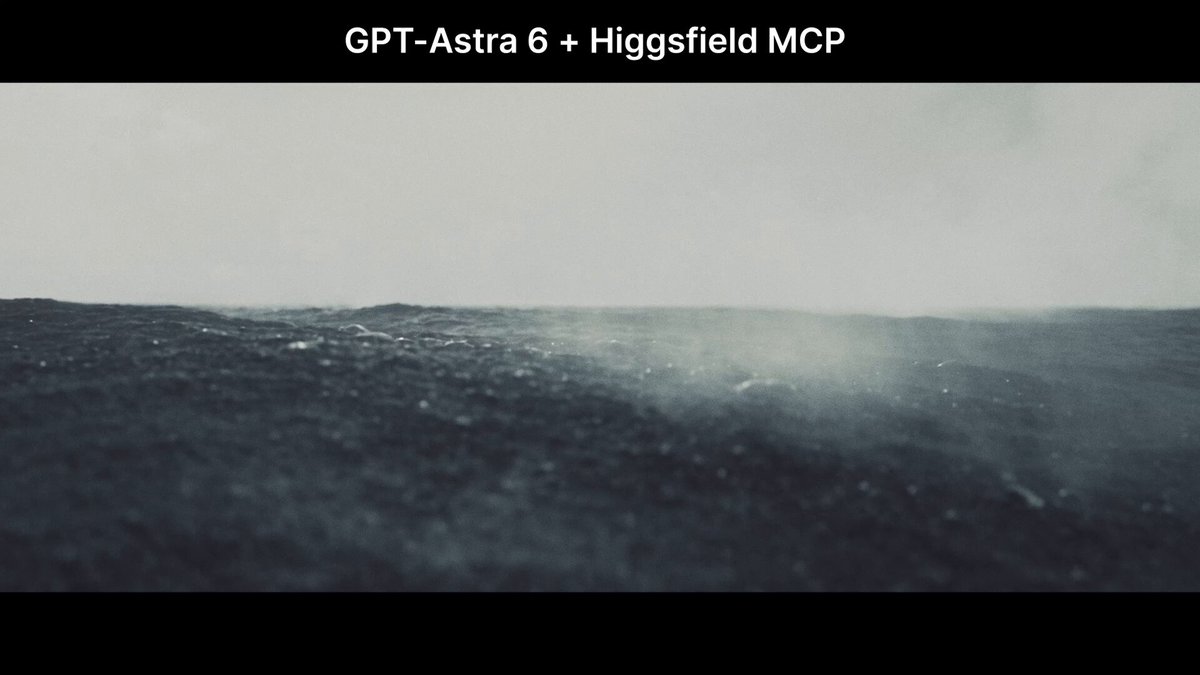
Something shifted at Higgsfield this week. Not a single product announcement, not a changelog entry, but a 48-hour cascade of demos that collectively amounted to the most complete public proof yet that a general-purpose AI agent can operate a professional film and animation stack from end to end. The company's stated ambition, posted on 6 September, is unambiguous: they are making the first movie created entirely by GPT-6 Astra computer-use, with Higgsfield as the production environment.
The demos that filled the two days around that announcement make the claim feel less like marketing and more like a production diary. GPT-6 Astra colour-graded Apple Log 2 footage in DaVinci Resolve in four minutes, matching a reference image "like a professional colorist." It took over After Effects, analysed a reference video, and rebuilt its motion elements in a transparent, fully editable composition. It blocked out a sword-fight anime previs in Blender, generated shots with Seedance 2.5, and cut a final edit, preserving character and location consistency across the whole piece. It composed a piano waltz, built a 3D pianist whose hands track every note, and rendered it from multiple switchable camera angles. It rebuilt New York in 3D in twenty minutes using Blender and Higgsfield, then produced a 500-year time-lapse of Manhattan growing from forest to metropolis to speculative future. A separate session produced a kids' cartoon, edited it in Premiere Pro, and uploaded it to a live YouTube channel complete with custom titles and tags.
What the tool stack actually is
Higgsfield is functioning here as a computer-use host. GPT-6 Astra does not have its own 3D renderer or compositor; it operates the software a professional would already have open, via the Higgsfield MCP (Model Context Protocol) layer and, in some cases, direct desktop control. That distinction matters for workflow planning. You are not getting a self-contained AI studio; you are getting an agent that can drive your existing licensed software. Blender, Cinema 4D, Houdini, DaVinci Resolve, Premiere Pro, After Effects, Photoshop, Krita, Procreate, Figma, TouchDesigner, Adobe Illustrator and Roblox all appeared across the demo set. The agent routed around a frozen file picker in Illustrator by switching to Finder to complete the export, which is either reassuring or unsettling depending on your appetite for autonomous problem-solving.
What was not said
No completed film has been released. The announcement framing is forward-looking: "We're making the first movie entirely with GPT-6 Astra computer-use" is a work-in-progress statement, not a deliverable. No runtime, genre, or release window was given. The demos are curated highlights, not a continuous uncut session, so the failure modes, iteration loops, and human interventions between takes are not visible. Pricing for Higgsfield Supercomputer access, which appears to be the compute layer running these sessions, was not disclosed in any of the posts. The Houdini integration was described as "our only first test," suggesting agentic VFX in that environment is early-stage.
What it changes in a real workflow
The colour-grading demo is the most immediately transferable. A four-minute reference-matched grade in DaVinci Resolve, with the agent operating the application directly, is a task that currently occupies a meaningful chunk of a small production's post schedule. If that result holds up on real projects, not curated demos, it is a genuine time-saving at a stage where AI tools have historically been weakest.
The anime previs pipeline is the one to watch for narrative filmmakers. The described flow, story brief to Blender previs to Seedance 2.5 shot generation to final cut with consistent characters and locations, is essentially the complete short-film pipeline that every independent AI filmmaker is currently stitching together manually across five or six separate tools. An agent that moves between those tools and holds context across them would remove the biggest friction point in the process.
The After Effects demo, where the agent builds fully editable compositions with assets on separate layers and transparent backgrounds, is worth testing by motion designers who currently hand-key every element. Reusable, editable output from an agent session is meaningfully different from a rendered deliverable you cannot touch.
What to test first
If you have Higgsfield access, the colour-grading session is the lowest-risk starting point: the input is footage you already have, the output is measurable against what a human colourist would deliver, and the four-minute claim is easy to verify or refute. The Blender-to-Seedance 2.5 pipeline is the second test worth running if you have an animatic or previs brief ready. The Houdini and TouchDesigner integrations are interesting but clearly early; treat them as experiments, not production tools yet.
The bigger question the demos do not answer is repeatability. A curated 30-post demo reel across two days is evidence of capability ceilings, not of average-case performance. The first movie made with GPT-6 Astra computer-use will be far more informative than any single demo clip. Until it exists, the workflow value here is real but unquantified.
Sources: The movie announcement · Kids' cartoon in Premiere, uploaded to YouTube · New York rebuilt in 3D in 20 minutes · DaVinci Resolve colour grade · After Effects motion rebuild · Anime previs-to-final-cut pipeline · Piano waltz with animated 3D pianist · Houdini agentic VFX first test