Fal's H3 Max family now generates Full HD video in real time, and a 24/7 AI wildlife live stream is already running on it
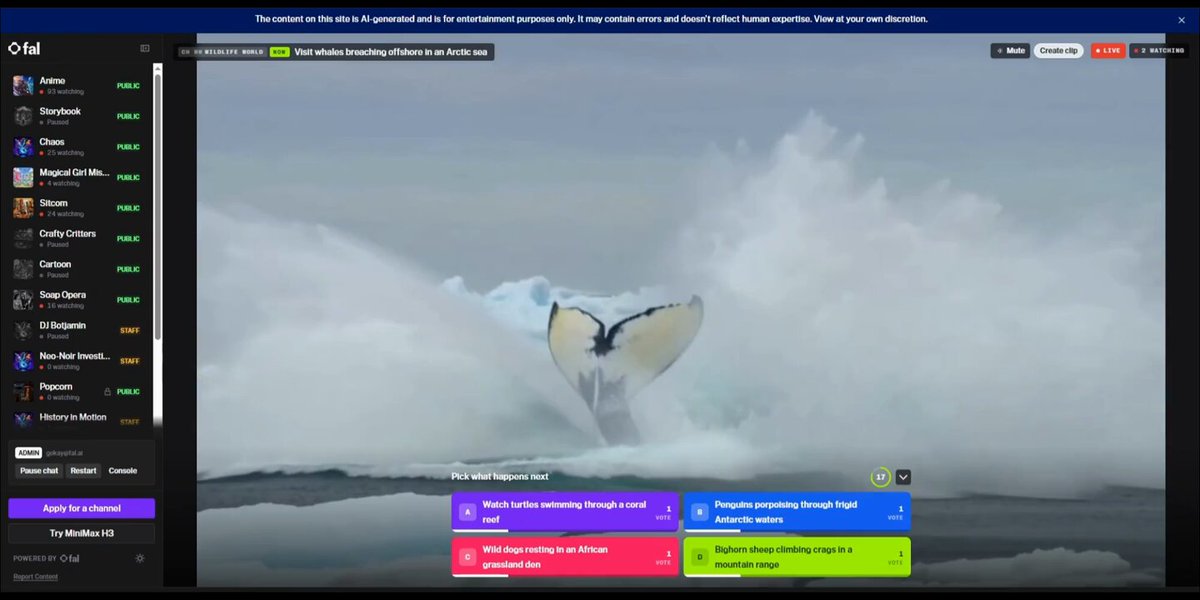
Fal has upgraded both H3 Max and H3 Max Turbo to native 1080p generation at real-time speeds, while simultaneously launching Wildlife World, a viewer-directed AI wildlife stream powered by H3 Max Director.
Fal has pushed a significant update to both H3 Max and H3 Max Turbo: native Full HD generation, running in real time. Five seconds of 1080p video in under five seconds of generation time. That is not a compression trick or an upscale pass bolted on at the end. It is the model outputting at resolution, at speed, simultaneously.
For working AI filmmakers, this closes a gap that has been quietly annoying for months. The previous workflow was generate at a lower resolution, upscale externally, review, repeat. Each upscale step introduced latency, potential artefacts, and a cost layer. Real-time Full HD generation collapses that loop into one step. You see the actual deliverable frame quality during iteration, not an approximation of it.
What was announced
Per @fal, both H3 Max and H3 Max Turbo now generate at 1080p natively. The Turbo variant was already the fastest and cheapest option in the H3 family, so this update means you are no longer trading resolution for speed. Both resolution tiers are now available across Text to Video, Image to Video, and Reference to Video endpoints, with direct links live as of 7 September 2026.
Separately, fal also launched Wildlife World, a 24/7 AI-generated live stream built on H3 Max Director, the cinematic-control tier of the same model family. Viewers vote on the next environment, from rainforest canopies to coral reefs, and the stream generates continuously in response. It is a public stress test and a showcase rolled into one, and it is running right now.
What this changes in practice
The previous alternative for anyone needing 1080p output was a two-stage pipeline: generate at 720p or lower, then run a separate upscale job through something like Topaz or a fal-hosted upscale endpoint. That adds time and cost to every clip. At the iteration stage, when you are running ten prompt variants to find the right shot, those costs compound.
Real-time Full HD means the iteration loop now operates at final output quality. A shot that looks good in the preview is already the deliverable. That is a meaningful workflow change for anyone producing content at volume, particularly for short-form commercial work where turnaround is measured in hours.
The Turbo variant specifically is worth watching. It was already positioned as the most cost-efficient option after fal halved its price in a recent update. Adding 1080p output to Turbo without a price announcement suggests fal is absorbing the resolution upgrade at the existing price point, though no explicit confirmation of pricing terms was included in the announcement.
What was not said
Fal did not announce a change to maximum clip duration alongside the resolution upgrade. The real-time benchmark of five seconds in under five seconds applies to five-second clips; how generation time scales at longer durations is not stated. There is also no published data on whether artefact rates or consistency metrics change at 1080p versus the previous output resolution. Those are things to test directly before committing it to a production pipeline.
Wildlife World is described as AI-generated and viewer-directed, but the degree of human curation between generation cycles and final broadcast is not specified. For filmmakers interested in it as a reference for what H3 Max Director can do unsupervised over long durations, that distinction matters.
Where to start
The most useful first test is a direct A/B comparison: take a clip you have previously generated and upscaled externally, regenerate it through H3 Max at 1080p, and compare frame sharpness, edge consistency and motion smoothness. If the native output matches or exceeds your upscale pipeline, you can retire that extra step entirely. The Reference to Video endpoint is particularly worth testing for character-consistent work, where upscale artefacts tend to be most visible around facial features and fine detail. Wildlife World is worth a watch for a sense of what sustained real-time generation looks like at the Director quality tier, which is the one built for cinematic control rather than raw speed.