WanGP brings Wan 2.2, LTX 2 and Hunyuan Video to GPUs most AI video tools have abandoned
An open-source project called WanGP bundles a dozen leading video and image models into a single web UI that runs on as little as 6 GB of VRAM, covering hardware as old as GTX 10-series Nvidia cards and AMD GPUs that most commercial platforms never supported.
If you have been watching the wave of powerful AI video models land over the past year while quietly wondering whether your RTX 3060 or ageing AMD card is simply going to be left behind, WanGP is the project worth stopping for.
Highlighted this week by @MAXdeg0, WanGP is an open-source, locally-run web UI that consolidates a remarkable number of the models that matter right now: Wan 2.1 and 2.2, LTX-Video 2, Qwen Image, Hunyuan Video, FLUX and more, all optimised to run on as little as 6 GB of VRAM. That is a significant claim. Most of the tools competing in this space have quietly drawn a line at 12 GB or higher. WanGP explicitly claims support for older Nvidia cards going back to the RTX 10XX and GTX 10-series, and for AMD GPUs that commercial platforms have never bothered to address.
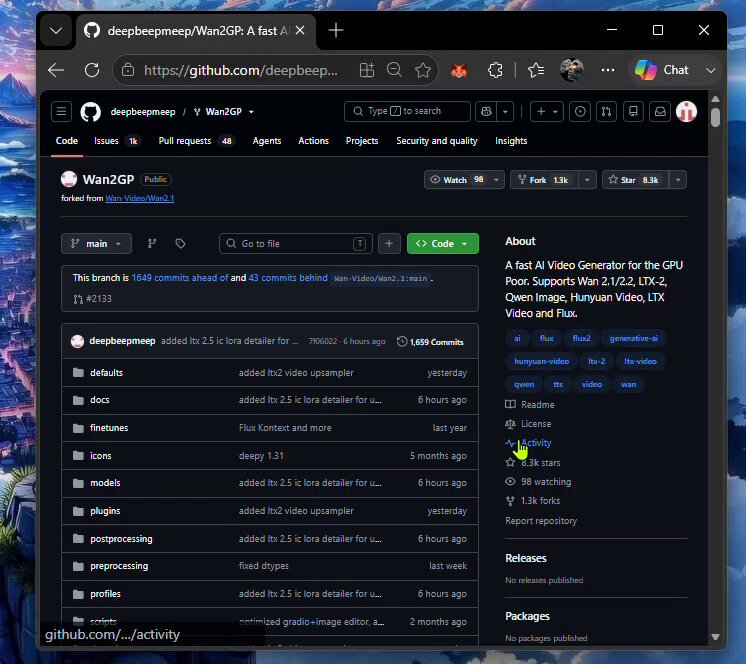
What it actually includes
The project is not simply a thin wrapper around model weights. Per the post by @MAXdeg0, WanGP ships with a full web UI, LoRA support, quantised checkpoints in int8, fp8 and GGUF format, a generation queue, and what is described as an MCP server for agent integration. That last point is worth noting: it means WanGP can, in principle, be slotted into automated pipelines that call models programmatically, not just used interactively through a browser tab.
The quantisation options are the real engine behind the low-VRAM numbers. Running Wan 2.2 at int8 or GGUF on a 6 GB card will not match a 24 GB card running at full precision, and that is an honest caveat the project does not hide. But it means the model runs at all, which is more than most alternatives offer on that hardware.
What it changes in practice
The AI video landscape has bifurcated sharply this year. On one side, cloud-based platforms charge per generation and control which models you can access. On the other, local tools like ComfyUI require significant setup knowledge and often assume high-end hardware. WanGP is trying to occupy the gap: a batteries-included local environment that does not demand a premium GPU.
For a filmmaker running Wan 2.2 or LTX-Video 2 through a commercial API, the cost per generation can add up quickly, especially during iterative prompt development. Running the same model locally, even at reduced precision, eliminates per-clip charges entirely. That arithmetic gets compelling fast if you are generating dozens of test shots before committing to a final render.
LoRA support is the other meaningful piece. Custom character or style LoRAs trained on Wan or FLUX can be loaded directly, which matters if you are trying to maintain visual consistency across a project. Commercial platforms vary wildly in whether they support user LoRAs at all.
What is still unknown
No date is given for this discovery, though the project itself appears to have been in active development for some time. No benchmarks are cited comparing WanGP's quantised output quality against full-precision runs on higher-end hardware, so the quality ceiling at 6 GB is genuinely unclear. The claim that it works on AMD GPUs is notable, but AMD support for AI inference remains patchy depending on the specific card, driver version and operating system, and no specific AMD models are named. The MCP server feature is mentioned but not explained in any detail, so its practical utility for workflow automation is an open question until you test it.
Installation complexity is also unaddressed in the post. Web UI projects of this kind can range from a one-click installer to a multi-step environment setup that defeats less technical users. Checking the project's own documentation before assuming it will be straightforward is sensible.
Where to start
If you have a GPU sitting between 6 GB and 12 GB VRAM, or an AMD card that current tooling ignores, WanGP is the most practical first test for running Wan 2.2 or LTX-Video 2 locally. Start with the GGUF quantisation option for your VRAM budget, generate a known prompt you have already run on a commercial platform, and compare the output directly. That comparison will tell you immediately whether the quality trade-off is acceptable for your use case. For prompt development and iteration, where you care more about motion and composition than final pixel quality, the trade-off is likely to be worthwhile. For final delivery renders, the answer depends entirely on what you see in that first test.