Wan 3.0 inside Magnific can turn two separate character references into a single believable movie scene, and that solves one of AI video's hardest problems
Multiple creators have independently tested Wan 3.0 via Magnific's character-reference pipeline and found it can composite two distinct character inputs into one coherent, emotionally convincing shot, something that has consistently broken every earlier generation of AI video tools.
Multi-character consistency has been the wall that stops most AI video projects before they start. You can generate a convincing lone figure, a beautiful environment, an action beat that lands. The moment a second character enters the same frame, identity dissolves, faces drift, and the scene falls apart in a way that no prompt engineering has reliably fixed. A cluster of independent tests this week suggests that pairing Wan 3.0 with Magnific's reference pipeline is a credible first answer to that problem.
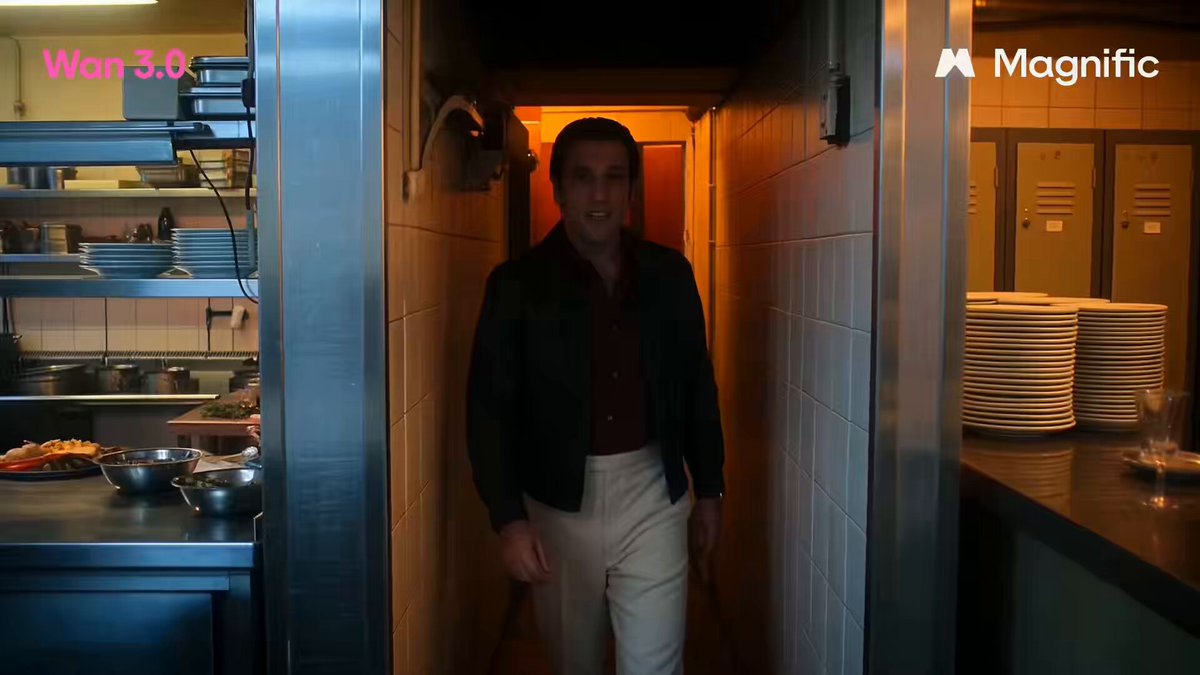
Three creators working independently, each starting from a different brief, arrived at the same finding: you can feed Wan 3.0 two separate character references inside Magnific and receive a single output shot where both figures hold. @xetgepete began with a character sheet, no filmed actor, no pre-existing footage, and produced what reads as a scene from a feature film. @OliviaReedai specifically set out to stress-test the two-character problem, describing the result as feeling like a shot from an actual movie. @EnzoSanchezIA used just a character reference and a street reference, and landed a frame cinematic enough to pass for location photography.
What is actually happening in the pipeline
Magnific has positioned itself as an enhancement and upscaling layer, but its reference-injection approach is doing something more structurally useful here. Wan 3.0 receives the stylistic and identity anchors before generation rather than as a post-process correction, which appears to be what keeps two characters coherent within a single generation pass. The key distinction from older workarounds, such as generating characters separately and compositing in post, is that the spatial relationship between figures, their lighting, and their eyeline interaction are solved inside the generation itself.
None of the three creators have published controlled comparisons, so it is worth being precise about what has and has not been demonstrated. These are single successful outputs shown publicly, not benchmarks across dozens of attempts. Consistency across a full sequence of shots, rather than one hero frame, remains unconfirmed. The degree to which character identity holds across costume changes, different lighting conditions, or emotionally demanding close-ups is not yet tested in public.
What this changes in a real workflow
For anyone building a short film or a scripted series with recurring characters, the practical implication is significant. The previous approach was to avoid two-shots entirely, cutting between singles and relying on editing to imply co-presence, or to use an actor reference for one character and accept that the second would be generated fresh each time and inevitably drift. Neither option produced the kind of scene coverage that lets you build real narrative momentum.
If the Magnific and Wan 3.0 pairing holds under production conditions, the workflow changes from avoiding two-character scenes to planning them. That means storyboards can include over-the-shoulder shots, reaction cutaways, and dialogue staging that were previously too risky to attempt in AI video. The creative ceiling moves up a floor.
What to test first
If you want to verify this for your own project before committing to a sequence, the logical first test is a simple over-the-shoulder shot with two character references you have already used elsewhere and know individually. Check whether both faces hold at the end of the clip with the same fidelity they hold at the start. Then try a second take where the characters are facing each other directly, since frontal two-shots are harder to anchor than profiles or thirds. If those pass, attempt a low-angle or high-angle variation to confirm the references survive a camera position change.
What is still unknown
No pricing for Magnific's reference tiers has been cited in any of the posts. No generation time benchmarks are available. It is not clear whether the pipeline works equally well with stylised character references, such as illustrated or 3D character sheets, versus photographic references, though @xetgepete did use a character sheet successfully. The question of whether Wan 3.0 specifically is required, or whether other base models routed through Magnific would produce comparable results, is also open. These are the gaps to watch as more creators publish their own tests.
For working AI filmmakers, this is the story to follow closely this week. Multi-character scene coverage is not a nice-to-have; it is a prerequisite for anything that attempts real drama. Three independent reports landing in the same place in the same 48-hour window is not confirmation, but it is a strong signal that something worth investigating is now accessible at the consumer level.