Wan 3.0 debuts at number one on the Artificial Analysis video editing leaderboard and lands top three in text-to-video, making it the strongest all-in-one contender right now
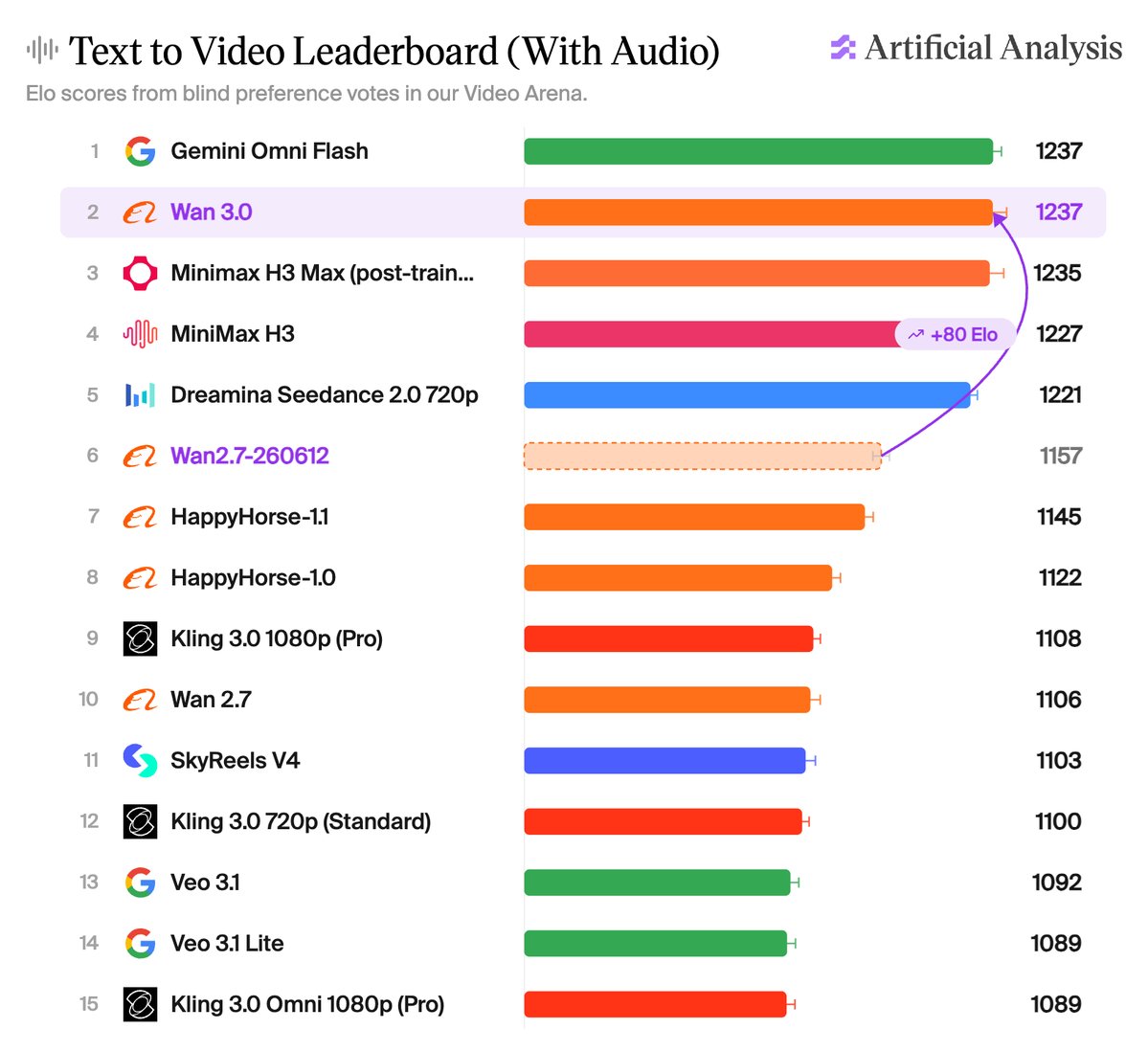
Alibaba's Wan 3.0 has posted the highest video editing score on the Artificial Analysis leaderboard and sits a narrow seven points behind MiniMax H3 Max in text-to-video, a result that puts genuine pressure on every specialist model in the field.
Alibaba's Wan 3.0 has arrived on the leaderboards with more force than almost anyone expected. Per creator @ArtificialAnlys, the model has debuted at number one on the Artificial Analysis Video Editing leaderboard and landed at a close second in Text-to-Video with Audio, sitting just seven points behind the current leader, MiniMax H3 Max. That is not the result of a niche model doing one thing well. It is a generalist system placing at the very top across two distinct disciplines simultaneously, which is a different kind of achievement.
The Image-to-Video picture reinforces the pattern. Per @arena, Wan 3.0 reached third place in the Image-to-Video Arena with 1,481 points, a 53-point improvement over its predecessor Wan 2.7. That predecessor sat at tenth. The jump from tenth to third is the sort of revision that changes how you think about a lineage. Wan was already a credible open-weight option. Wan 3.0 is now competing directly with the closed commercial leaders.
What Wan 3.0 actually does
Wan 3.0 positions itself as a single unified system for multimodal creative direction. It accepts text, images, video, audio, documents, and web pages as inputs, generates up to 30 seconds at 1080p with native audio, and supports Text-to-Video, Image-to-Video, and reference-based generation within the same model. The practical value of that architecture is consolidation: one API, one prompt logic, one set of generation parameters to learn, regardless of whether you are starting from a blank brief or an existing reference frame.
For AI filmmakers, the video editing placement is arguably the more interesting number. Text-to-Video quality has been improving across the board; editing, meaning the ability to apply targeted changes to existing footage without destroying the rest of the frame, remains genuinely hard. Ranking first there suggests Wan 3.0 handles the masking and motion consistency problems that make editing models frustrating in practice.
How it sits against the alternatives
MiniMax H3 Max still leads in Text-to-Video with Audio and holds the top Image-to-Video Arena position. Seedance 2.5 has been the reference choice for physics fidelity and prompt adherence, a distinction that has held even as other models have improved. Wan 3.0 does not obviously dethrone either of those benchmarks for every use case. What it does is offer a credible alternative that does not require you to pick between editing capability and generation quality.
The open-weight angle matters here. Wan 3.0's weights are available, which means self-hosted deployments, fine-tuning on proprietary character libraries, and integration into custom pipelines without per-second billing. For studios running consistent series or AI influencer workflows at volume, that is a cost and control argument that closed APIs cannot match. It is also why the leaderboard placement carries more weight than it would for a purely commercial model: the result is not just a sales claim, it is something any practitioner can independently reproduce.
What is still unknown
No pricing tiers or per-second generation costs for managed API access have been published alongside these results. Inference speed at 1080p for the full 30-second generation window is not documented in the benchmark posts. The native audio quality, a stated feature, has not been independently stress-tested in the sources available here, so that capability should be verified against your specific voiceover or sound-design requirements before committing a pipeline to it.
The 53-point Arena improvement from Wan 2.7 to Wan 3.0 is substantial, but Arena scores reflect community voting on head-to-head comparisons. They measure general preference, not performance on specific filmmaking tasks such as multi-shot character consistency or hard-cut scene transitions. Those remain things you will need to test against your own reference material.
What to test first
If you are currently running a Seedance 2.5 or H3 Max pipeline and want to know whether Wan 3.0 is worth the context switch, the editing leaderboard result is the most direct reason to run a comparison. Take a clip you have already graded or stabilised and run a targeted edit through Wan 3.0's reference-based pipeline. That single test will tell you more than any benchmark score about whether its masking behaviour fits your workflow.
For anyone building on open-weight infrastructure, the model is worth pulling now. First place in video editing is the strongest result any Wan version has posted, and leaderboard positions at this tier tend to attract community tooling, fine-tunes, and integration work quickly. Getting familiar with the architecture before that ecosystem matures is the most useful thing you can do with the next free afternoon.
---
Sources: @ArtificialAnlys (leaderboard debut report), @arena (Image-to-Video Arena placement)