Topaz Labs' Astra 2 upscaling model took Aurora Aura's AI film from a soft 480p draft to a 4096×4096 planetarium master, and that is a new benchmark for large-format AI video
Japanese filmmaker Aurora Aura used Topaz Labs' Astra 2 and Starlight Precise 2.5 to take AI-generated footage to a 4096×4096 dome display at Konica Minolta's PLANETARIA YOKOHAMA. The full workflow is now public, and it reframes upscaling as a core production step rather than a finishing touch.
There is a problem that sits quietly at the back of every AI video project: the footage looks convincing on a laptop screen, and falls apart the moment it gets large. Softness, noise, and a particular kind of synthetic flatness that only reveals itself at scale. Aurora Aura, a Japanese filmmaker, decided to test how far that ceiling could be pushed. The answer, documented in detail by @topazlabs, is a 4096×4096 dome film, Solaris Breath, screened at Konica Minolta's PLANETARIA YOKOHAMA. The pipeline that got it there is worth studying.
The film began, as most AI video projects do now, in familiar tools. Stills were generated in Midjourney and NanoBanana Pro. Those source images were upscaled in Topaz Labs' Gigapixel before video generation even began, which is a workflow choice most creators skip and probably shouldn't. Video was then generated across four separate models: Grok Imagine, PixVerse, ViduAI, and Seedance 2.5. From there, the footage went to Adobe Premiere Pro and After Effects for conventional editorial work. A VR preview pass on Meta Quest 3 served as a large-display proxy review. Finally, Topaz Labs' Starlight Precise 2.5 and Astra 2 models handled the upscale to the 4096×4096 master.
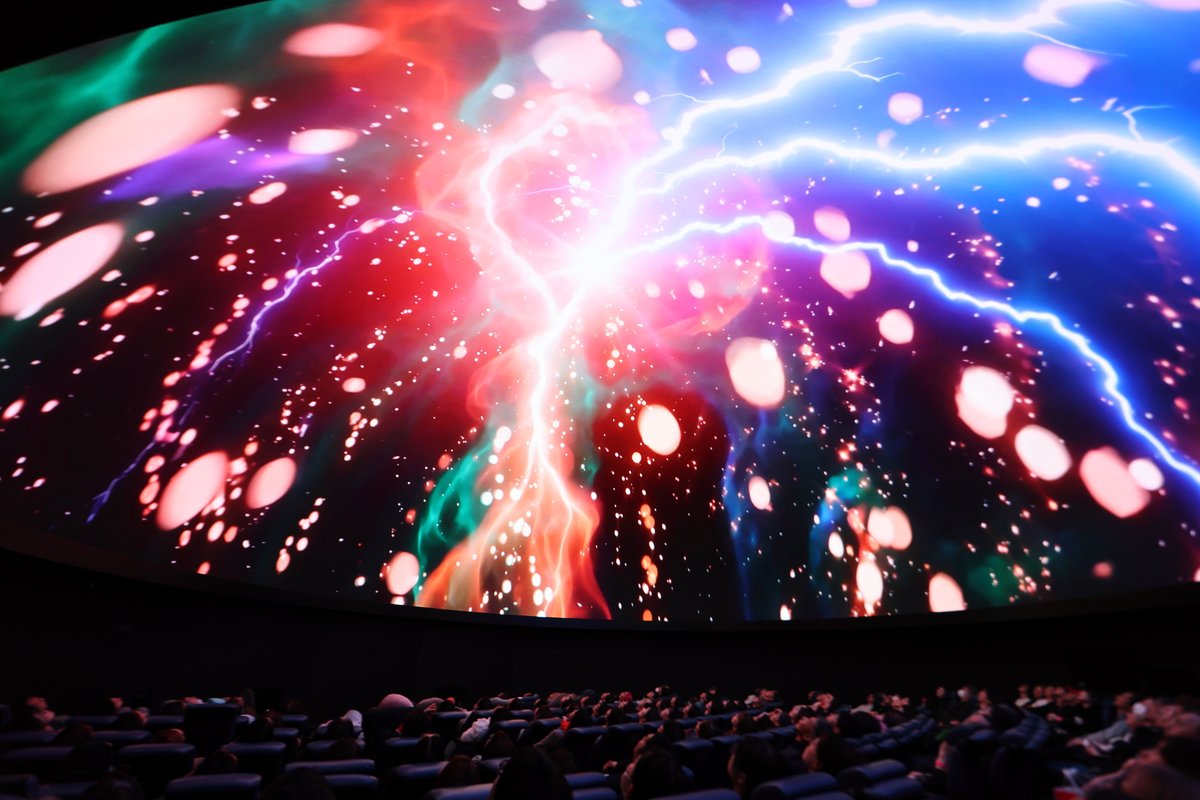
What Astra 2 actually does at this scale
In Aurora Aura's own words, quoted by @topazlabs: "Fine detail at large scale is one of the weak points of AI-generated video. The Astra 2 model doesn't just reduce softness and noise, it adds convincing detail that becomes increasingly important as the image gets larger." That distinction matters. Conventional upscaling sharpens what is already there. Astra 2, according to this account, reconstructs plausible detail that was never in the source. At planetarium resolution that is not a cosmetic difference; it is what separates footage that holds the dome from footage that exposes itself.
The two-model approach, Starlight Precise 2.5 alongside Astra 2, suggests a staged strategy: one pass for noise and temporal consistency, a second for detail synthesis. Topaz has not published a formal breakdown of how these models divide responsibility, so the precise interaction between them remains unclear from the available information.
What the workflow actually implies for AI filmmakers
The most instructive moment in the pipeline is the earliest one. Upscaling source stills in Gigapixel before video generation, not after, is a deliberate choice. It means the video model is working from higher-quality texture data from the first frame. Creators who generate at low resolution to save credits and then upscale the output are working against themselves at every stage. This workflow reverses that logic.
The multi-model video generation step is also worth attention. Using four different video models, Grok Imagine, PixVerse, ViduAI, and Seedance 2.5, for a single film implies that no single model was adequate for every shot. This is a production reality that is rarely stated plainly: AI video generation at a quality level suitable for large-format exhibition is still a selective, multi-tool discipline.
The Meta Quest 3 proxy review step is a practical idea that costs almost nothing to adopt. Viewing footage in VR at a simulated large scale before committing to a full upscale pass surfaces problems early, when they are cheap to fix.
What is still unknown
No pricing or processing time for the Starlight Precise 2.5 and Astra 2 upscale passes is disclosed in the available posts. For a 4096×4096 master at feature length, compute cost is a real variable and the pipeline documentation does not address it. The film's runtime is also not stated, which makes any estimate of total render time impossible. Whether the Astra 2 model is available to individual creators through Topaz Labs' standard desktop tools, or whether this was a custom or enterprise engagement, is not confirmed. That is the question most worth asking Topaz Labs directly before planning a similar project.
For creators working in AI video at any display scale, the core lesson here is that upscaling deserves to be a planned production stage with its own budget and time allocation, not an afterthought. The fact that this approach produced work suitable for a professional planetarium installation is the most concrete evidence yet of what that investment can return.
---
Sources: @topazlabs workflow breakdown, pipeline detail post, full article link