Topaz Labs' Hyperion 2.5 converts AI-generated footage to true HDR, and it is now available via fal for any pipeline that needs it
Topaz Labs has released Hyperion 2.5, a new video model that converts standard 8-bit AI video into ProRes 10-bit, EXR 16-bit and H.265 10-bit HDR formats, and fal has simultaneously launched all 16 Topaz enhancement endpoints including Hyperion as API-accessible tools.
The most persistent problem with AI-generated video in professional post-production has not been resolution or motion quality. It has been bit depth. You can upscale a Seedance or Kling clip to 4K and it still arrives as an 8-bit SDR file that looks visibly wrong the moment you cut it next to live-action HDR footage in a high-end timeline. Topaz Labs has now taken direct aim at that problem.
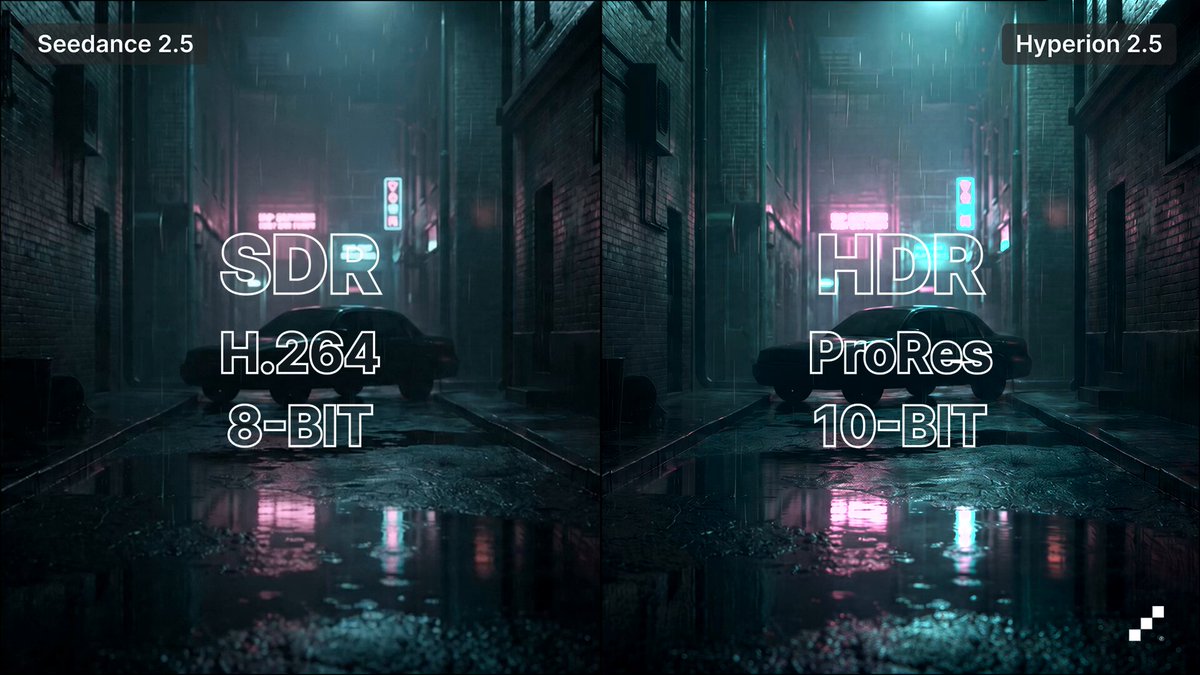
Hyperion 2.5 is a new video model from @topazlabs that converts 8-bit AI video into true HDR outputs: ProRes 10-bit for editorial and colour finishing workflows, EXR 16-bit for VFX compositing pipelines, and H.265 10-bit for delivery. The pitch is direct: AI footage can now sit alongside live action in professional and VFX pipelines without the bit-depth handshake breaking the grade. It is available now inside Topaz Astra, with support coming soon to the standalone Topaz Video application.
What fal adds to this
The release lands alongside a parallel announcement from @fal, which has brought all 16 Topaz enhancement endpoints onto its API infrastructure. The full suite includes Starlight Precise 2.6 for diffusion-based restoration, Wonder 3.5 for generative image upscaling, Astra 2 and Bloom 2 for creative upscaling, and the full Topaz precision family for video. Hyperion 2.5 is among them, meaning the HDR conversion step is now callable from any pipeline with an API key, not just from the Topaz desktop application. The fal endpoints are live now. Per @fal, the SDR-to-HDR endpoint specifically maps to Hyperion 2.5.
Why this matters for AI filmmakers
The format gap has been a quiet dealbreaker for anyone trying to deliver AI-assisted work to a broadcast or streaming colourist. Most AI video models output H.264 or H.265 8-bit files. A colourist working in DaVinci Resolve on a project with HDR deliverables cannot grade that material consistently alongside camera-original footage without significant manual intervention, and even then the results can look stitched together. ProRes 10-bit and EXR 16-bit are the formats those colourists and compositors actually expect.
For VFX artists specifically, EXR 16-bit is not a luxury. It is the interchange format for compositing in Nuke, Flame and similar tools. Being able to hand an AI-generated background or element off to a VFX department as an EXR rather than a compressed 8-bit clip changes the conversation about where AI video can sit in a hybrid pipeline.
The fal API layer matters because it removes the requirement to run Topaz desktop software locally during a render pipeline. You could call Hyperion 2.5 as a post-processing step in an automated workflow: generate a clip, pass it through an upscaler, then convert to HDR, all without manual intervention. That is not hypothetical; fal's existing infrastructure already handles Wan, Kling and Seedance generations in automated pipelines for some studios.
What is still unknown
Topaz has not published benchmark comparisons between Hyperion 2.5's HDR output and manually graded HDR conversions done by a colourist. The claim is that AI footage can sit alongside live action, but that is a qualitative assertion, not a measured one. Anecdotes are not benchmarks.
Pricing for the Hyperion 2.5 endpoint on fal has not been specified in the announcement posts. Topaz's desktop tools are subscription-based, but API pricing on fal is typically per-second or per-frame and can vary significantly by model. Test on a short clip before committing a long-form project.
The timeline for Hyperion 2.5 arriving in Topaz Video AI (the standalone application) is described only as "coming soon." No date was announced.
It is also worth noting that Hyperion is an HDR converter, not a denoiser or sharpener. Topaz's own team confirmed in replies that for general quality improvement before the HDR step, Starlight Precise 2.6 is the recommended pairing. Running both in sequence, upscale first then HDR-convert, appears to be the intended workflow for the highest-quality output.
What to test first
If you work in a hybrid live-action and AI-video pipeline, the most useful first test is a short sequence where you cut AI-generated footage against camera-original HDR material in your finishing application. Export the AI clip, run it through Hyperion 2.5 as ProRes 10-bit, import both into your colour session and check whether the grading handles them consistently without a visible seam. That is the real-world test that matters, and it is now possible to run it without a custom conversion workaround for the first time.
---
Sources: @topazlabs (Hyperion 2.5 announcement), @fal (all 16 Topaz endpoints on fal), @fal (individual endpoint links)