Runway has built a video model that drives real robot arms, and it tells AI filmmakers where Runway is heading
Runway's Praxis-1 predicts video and robot actions together, tops an NVIDIA leaderboard and claims 15.6x the speed of GPT-6 Astra. It is not a film tool, but it shows what Runway thinks video models are for.
Runway has released Praxis-1, and it is not a filmmaking tool. It is a video model that also decides what a robot arm should do next. Runway says it ranks first on NVIDIA's RoboLab-120 leaderboard and sits ahead of every open-weight vision-language-action model on the board, including π0.5 and GR00T N1.6.
That sounds a long way from your timeline. It is not. Runway's argument, stated in its own thread, is that general video is the most scalable source of robotics data. A model trained to predict video learns how objects behave, how hands move and what a task looks like partway through. The company is betting that the same skill that makes a convincing shot also makes a capable machine. If you work with AI video, that is the clearest statement yet of where one of the big video labs thinks the value sits.
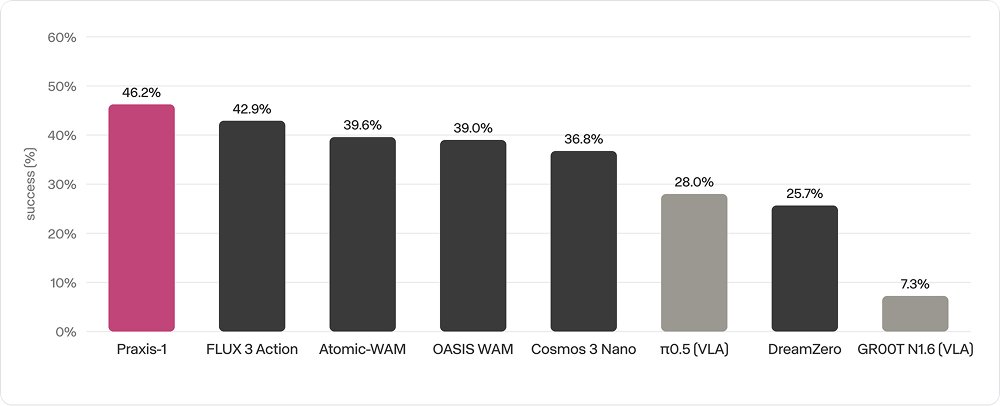
What Runway actually claimed
Per the @runwayml thread, Praxis-1 is a 27B-parameter mixture-of-experts diffusion transformer that predicts video and actions together. A technical report covers the architecture, training stages and results.
The headline numbers are these:
- On the same station and tasks, Praxis-1 finished 15.6x faster than GPT-6 Astra driving the arm, at 51x lower cost per completed task.
- Fine-tuned on Google's RT-1, a robot it never saw in training, it reached 80.0% on SimplerEnv, against 52.4% for the original RT-1 policy.
- With under 30 minutes of teleoperated demos, it succeeded in all 15 simulated trials on Noble Machines' robot.
These are Runway's own figures, from Runway's own report. Note the last one in particular. Fifteen simulated trials is a small sample, and it is simulation, not a physical floor. Treat it as a promising demo, not a benchmark you can plan a business around.
What is not said
There is no price, no release date for general access and no statement that Praxis-1 will reach the Runway app you use for video. The thread ends with a bare "Get started" link, and nothing in the posts tells us who can actually use it, or on what terms. The comparison against GPT-6 Astra is framed around driving a robot arm, so it says nothing about how either model handles a film shot.
It also does not say that Runway's video generators have changed. Praxis-1 is a separate model with a separate job. Nothing here promises better motion, longer clips or tighter physics in your next generation. That would be a guess, and I would not make it for them.
Why a filmmaker should still care
There are two practical reasons.
First, direction of travel. A lab that trains video models to understand how hands and objects interact has a strong reason to keep improving that understanding. Physical plausibility is the thing most AI video still fumbles, whether it is a hand closing on a cup or a prop that changes shape between frames. Runway is now measuring that kind of competence against external leaderboards, not just showing nice clips. That is a healthier yardstick than a cherry-picked reel.
Second, the economics. The claimed 51x lower cost per completed task is a reminder that a purpose-built video model can undercut a general frontier model on a narrow job. The lesson carries over. A specialised tool for a specific shot type may beat a giant general one on cost and speed. It is a pattern worth watching as more labs split their models by task.
What to test first
Nothing in this release is something you can drop into a project today, so the useful move is to watch and prepare.
1. Read the technical report if you care about how Runway frames video as a learning signal. It is the most direct window into how the company thinks about its models.
2. Keep a small set of physical-interaction test shots, such as hands handling objects, doors, pouring and tool use. When Runway's next film-facing model arrives, run those first. They are the fastest way to see whether any of this understanding has reached the creative side.
3. Do not change a pipeline on the strength of a robotics benchmark. Wait for something you can generate with.
Praxis-1 is a signal, not a feature. A good one, but a signal.
Sources: the announcement thread opener, benchmark claim, the architecture and technical report post, the speed and cost comparison, the general video training argument and RT-1 result, the low-data Noble Machines result, the get started link.