MiniMax H3 is now open weights with native stereo audio, and the community has already pushed it to 15 seconds of 768p video in under seven seconds
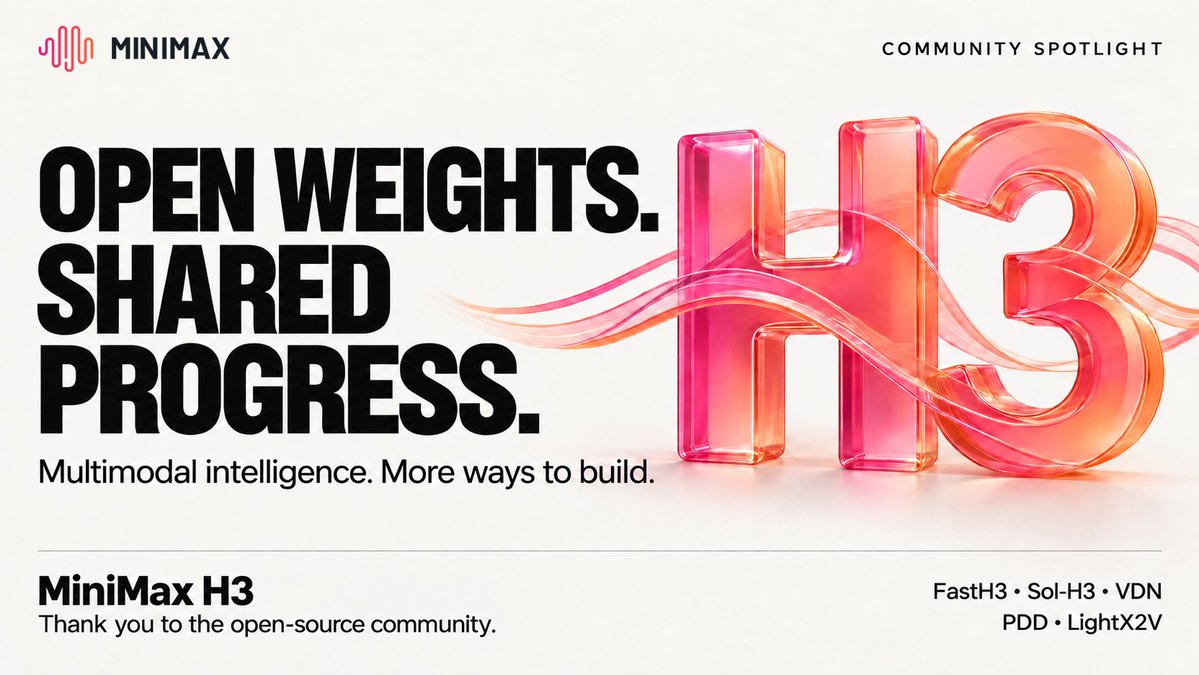
MiniMax has released open weights for its H3 video generation model, purpose-built for native stereo audio and multimodal reference control. Within weeks, the open-source community shipped two acceleration frameworks, FastH3 and Sol-H3, bringing inference speeds that no closed API has matched.
Open weights video generation has been catching up to closed models for months, but MiniMax H3 does something most open models have not even attempted: it bakes native stereo audio and multimodal reference control into the architecture from the start. That is not a post-processing trick or a separate audio pipeline bolted on at export. The model was built for it. And now, with the weights public, the open-source community has had a go at the inference stack, and the results are already embarrassing some commercial offerings on pure throughput.
The official @MiniMax_AI announcement lists two community acceleration frameworks that landed within the first weeks of release. FastH3, a collaboration between FastVideo, Nuva Lab and NVIDIA, applies four-step distillation and runs on both DGX Spark hardware and Apple Silicon. Sol-H3, from NVIDIA's SANA team, hits 15 seconds of 768p video with audio in 6.6 seconds on eight B300 GPUs under warm-inference conditions. Neither figure has been independently reproduced at scale in a filmmaker workflow, so treat them as lab benchmarks for now, not production promises.
What H3 actually does differently
Most open video models produce silent clips and leave audio synchronisation to the editor. H3 generates stereo audio as part of the same inference pass, which means the spatial audio field is computed alongside the visual frames, not retrofitted afterwards. For anyone scoring short-form AI content, product demos or social spots, that could collapse a post-production step entirely.
Multimodal reference control means you can supply an image, a video clip, a character sheet or a style reference as a conditioning input alongside the text prompt. This is the architecture that allows consistent character identity across shots without fine-tuning, which has been one of AI video's stubborn weak points. The announcement does not specify how many reference modalities can be combined in a single generation call, or what the resolution ceiling is outside the 768p Sol-H3 benchmark.
How it sits against the current alternatives
Closed models like Seedance 2.5 and Kling 3 offer strong character consistency and polished output but charge per generation and give you no access to the weights. You cannot distil them, quantise them or run them on local hardware. H3 changes that calculation entirely if the quality floor holds up under real production prompts, not just the cherry-picked demos that accompany every model release.
The Apple Silicon support via FastH3 is worth flagging specifically. A filmmaker running an M3 or M4 Ultra Mac Studio can, in principle, run H3 locally without renting cloud compute. The 4-step distillation is a significant quality-versus-speed trade-off, and no independent reviewer has yet published a quality comparison between the distilled FastH3 and the full model at equivalent resolution. That test is the one to watch for.
What to test first
If you have access to a DGX Spark or a high-memory Apple Silicon machine, the first thing worth running is a character consistency test across three or four shots using a single image reference, then checking whether the stereo audio field tracks the visual action spatially. That combination, visual continuity plus native spatial audio, is the workflow gap H3 is designed to close.
For most filmmakers on standard cloud GPU rentals, Sol-H3's 8×B300 configuration is out of reach today, but the FastH3 distilled path may be accessible via community inference endpoints as they appear on Hugging Face and Replicate. No pricing has been announced for any hosted H3 endpoint as of the time of writing.
What is still unknown
The announcement is light on specifics that matter in production: maximum clip duration, resolution options beyond 768p, the quality delta between the four-step distilled model and the full inference path, and whether the stereo audio generation holds up on music, dialogue and ambient sound equally. There is also no published evaluation against a standard benchmark, so quality claims rest on the community highlight reel rather than systematic testing.
None of that diminishes the structural importance of what has happened here. A model built for native audio-video synthesis is now open, accelerated, and running on hardware that a working filmmaker might actually own. The next question is not whether H3 is worth watching. It is how quickly the community fills in the production-grade tooling around it.