LTX-Video 2.5 is out as open weights, and it brings multishot generation and real-time performance to local filmmakers
Lightricks has released LTX-Video 2.5, an open-weights world model with multishot support, stronger prompt adherence, and character and scene consistency. NVIDIA is already offering an NVFP4 quantisation that claims 20 per cent faster generation and 40 per cent lower memory usage on RTX hardware.
Open-weights AI video just took a meaningful step forward. LTX-Video 2.5 is out, and it is not a minor point release. The new model brings multishot generation, stronger prompt adherence, and explicit character and scene consistency to a model you can run on your own hardware. For the subset of filmmakers who have been watching closed-API models eat the headlines while their local pipeline stagnated, this is the news they have been waiting for.
NVIDIA's RTX Spark team flagged the release alongside an NVFP4 quantisation path that the announcement claims delivers up to 20 per cent faster generation and 40 per cent lower memory usage compared to standard precision. Those numbers will matter enormously depending on what GPU you are sitting in front of, and they should be treated as headline figures until independent benchmarks arrive. Still, even discounted, the direction is right: more model capability arriving with a smaller VRAM footprint, not a larger one.
What multishot actually means for a production workflow
Single-shot AI video generation has been the quiet constraint that nobody talks about enough. You get one continuous take, one camera angle, one lighting setup. Cutting between those takes in post is possible but it collapses consistency. Characters drift. Lighting shifts. The edit feels assembled, not directed.
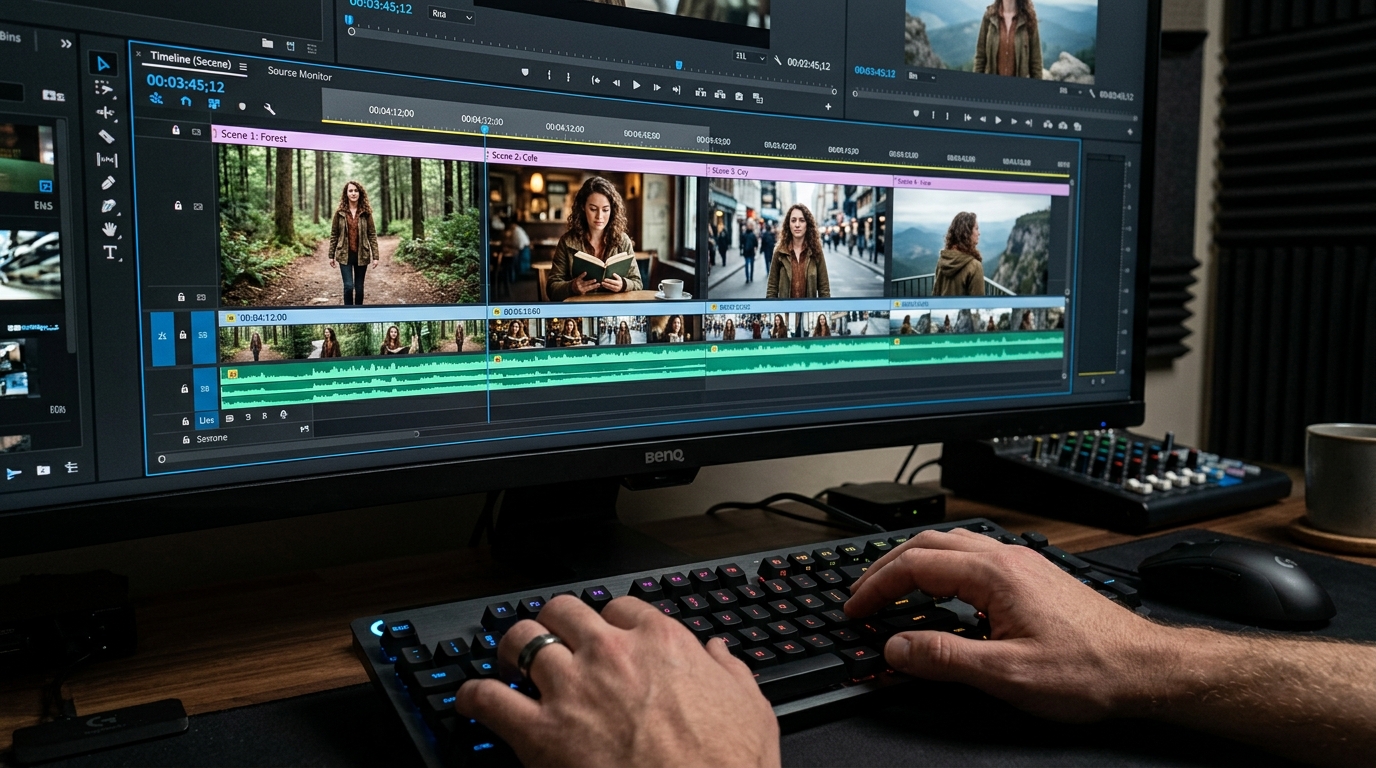
Multishot changes the unit of production. Instead of generating isolated clips and hoping they stitch, the model understands that shot A and shot B belong to the same scene. Character appearance, background continuity, and ambient lighting can remain coherent across cuts inside the model's own generation pass. Whether LTX-Video 2.5's implementation is robust enough to survive demanding scripts is still an open question. The announcement asserts the capability; real-world testing will define its limits.
The comparison to test first is straightforward: generate a three-shot scene in LTX 2.5 and compare the character consistency across cuts to your current workflow, whether that is chaining single-shot clips or using a closed API. If the drift is measurably lower, that is a pipeline change worth making.
The open-weights argument
For professional and semi-professional AI filmmakers, open weights mean three things that closed APIs cannot offer: no per-generation cost at inference time, the ability to fine-tune on your own characters or visual style, and the freedom to integrate the model into a custom pipeline without negotiating rate limits or terms of service changes.
LTX-Video has been one of the more practically useful open models in this space. Its architecture was built with real-time and creative applications in mind from the start, which is why it has historically run faster than models of comparable quality. Version 2.5 extends that philosophy, explicitly positioning itself as a world model suited to physical simulation, creative production, and real-time use cases. The "world model" framing is worth noting: it implies the model has some representation of how objects and environments behave over time, not just how they look frame to frame. What that means in practice for a narrative filmmaker, versus a VFX artist, versus a game developer, is not yet clear from the announcement alone.
What was not said
The announcement does not specify a context length for multishot generation or how many distinct shots can be held in a single generation pass. It does not detail what "character consistency" means quantitatively or how it degrades as scenes grow more complex. No pricing tiers are listed because this is open weights. There is no roadmap for ControlNet-style conditioning or audio-to-video synchronisation, both of which matter heavily to working filmmakers.
The NVFP4 path is specific to NVIDIA RTX hardware. AMD and Apple Silicon users will need to wait for community quantisation work or alternative inference paths to catch up, which typically happens within weeks of a notable open release, but is not guaranteed.
Where to start
Per @NVIDIARTXSpark, the NVFP4 local run is the fastest entry point for RTX users. Pull the weights, run the NVFP4 path, and immediately stress-test the multishot and consistency claims on a scene you have already built in another pipeline. That gives you a direct comparison baseline. If you are not on RTX hardware, the standard weights are still there. The memory savings just will not apply.
Open-weights video models have been catching up to closed APIs faster than most expected. LTX-Video 2.5 does not end that race, but it closes the gap meaningfully, and it does so at a price point of zero per generation. That is a hard number to argue with.