How to keep your character looking like the same person across six cuts
Identity drift is the most common reason an AI short falls apart. The fix is boring, repeatable, and mostly happens before you generate anything.
The single most common failure in AI video is not a bad shot. It is a good shot followed by another good shot of somebody who is nearly, but not quite, the same person. Viewers notice within a second, even if they cannot say why, and it is the fastest way to lose them.
Here is what actually works, drawn from the prompts in our library that hold identity across long sequences.
Fix the description once, then never rewrite it
Decide your character's three or four unchanging physical facts and write them as a fixed block of words. Not "a young woman with dark hair" in one shot and "a woman in her twenties, brunette" in the next. The exact same words, every time the character is mentioned, across every prompt in the sequence.
This sounds trivial. It is the single highest-impact habit in prompt craft, and most people break it by paragraph three because they are writing naturally rather than mechanically.
Put identity before action
In prompts that hold up, the character description sits near the top and the action follows. Prompts that open with a dramatic action and describe the character afterwards drift more. Treat the identity block as a header, not a detail.
Use references for the face, words for everything else
If your model takes reference images, spend them on the face and costume rather than the scene. A reference set that covers three angles of the head plus one full-body costume shot does more for continuity than a dozen mood images. Scene, lighting and camera are better handled in language, where you can change them shot to shot without disturbing the identity.
Change one thing at a time
When a shot drifts, the instinct is to rewrite the whole prompt. Resist it. Change one element, regenerate, compare. Rewriting everything means you never learn which word caused the drift, and you will hit the same wall on the next project.
Accept what the model cannot hold
Some things drift no matter what you do: hands in close range, jewellery, small logos and patterns, and the exact geometry of a face in extreme profile. The professional move is to design around them, not fight them. Shoot the profile as a silhouette, keep hands out of close-ups, and make the costume simple enough to describe in six words.
The test
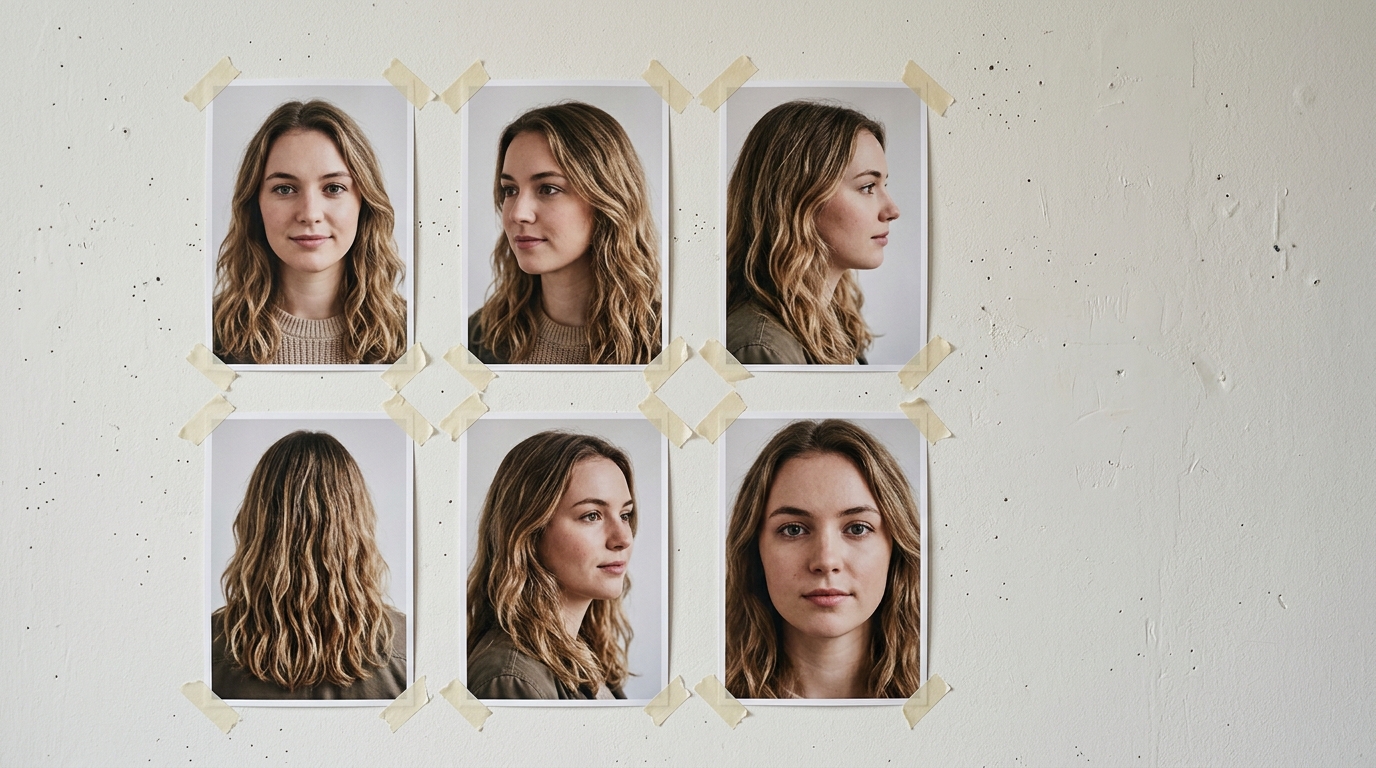
Before you commit to a sequence, generate your character in six shots at different angles, put the frames side by side and look only at the face. If you would not accept them as the same person, no amount of editing will save the sequence. Fixing it now costs an hour; fixing it after you have cut the film costs the film.
Drawn from patterns across the Unhindered AI video prompts library, where every prompt is analysed for where it holds and where it breaks.