Higgsfield's GPT-6 Astra plugin takes over After Effects and turns a text prompt into a fully editable 3D animation engine
Higgsfield has shipped a plugin that lets GPT-6 Astra write, install and run complex 3D engines directly inside After Effects, from animated neural networks to product commercials, all from a single prompt typed in ChatGPT.
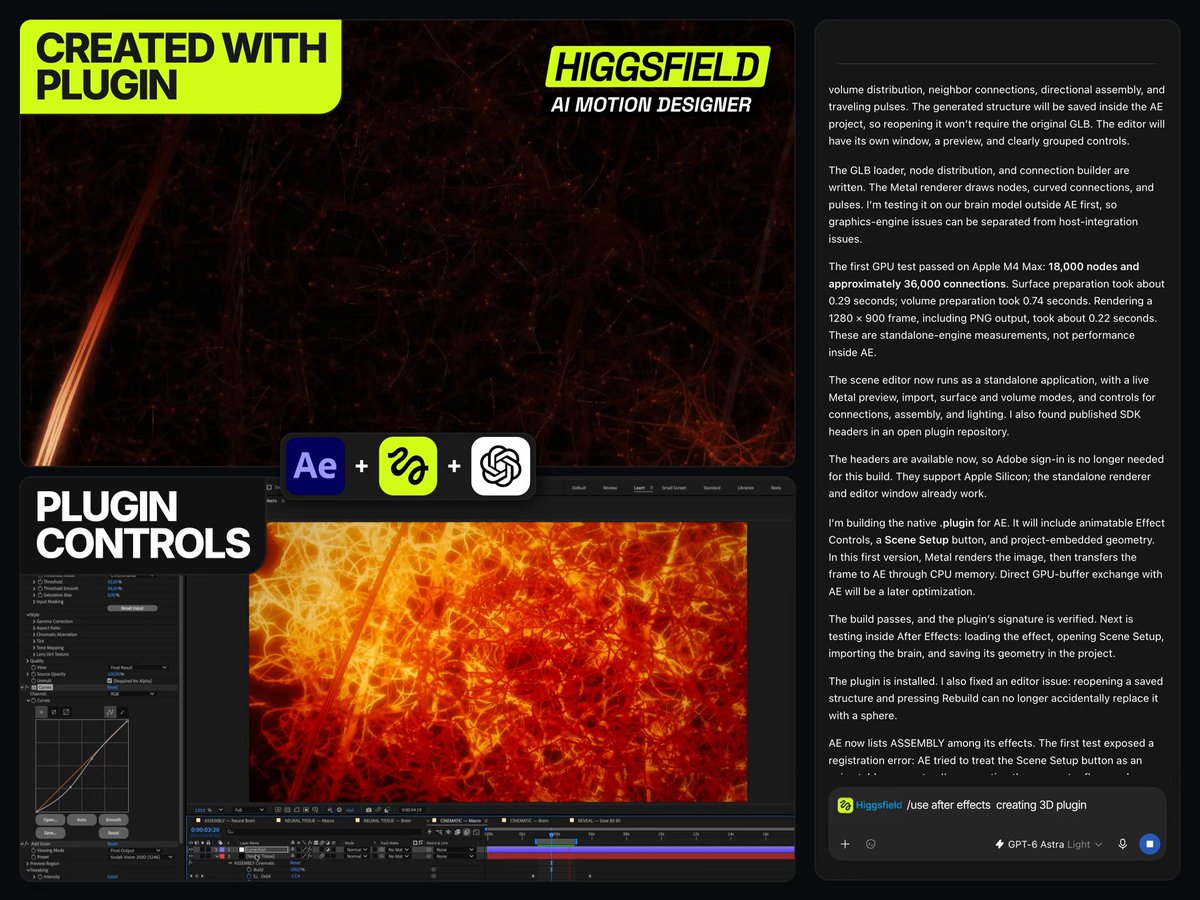
After Effects has spent thirty years accumulating complexity that takes years to master. Higgsfield has just short-circuited the entire learning curve. The studio's new plugin, accessed by typing `@Higgsfield /use-after-effects` inside ChatGPT, lets GPT-6 Astra write a GPU plugin on demand and install it directly into a live After Effects session. The result is not a pre-baked template. It is a fully editable, bespoke 3D engine that the model builds to match your brief and hands back with every parameter exposed.
The demos Higgsfield posted across 10–12 September show the range of what the pipeline can produce. A prompt requesting a 3D brain with individually animated neural connections produced a working AE composition with hundreds of editable objects. A product-website URL fed into the system generated a finished commercial, camera movement, lighting, typography and all, with every element still live in the timeline. The most immediately practical demo showed automatic aspect-ratio reframing: a task that is genuinely one of the most time-consuming jobs in any professional AE workflow, now reduced to a single instruction.
What this actually changes in a working pipeline
The critical distinction here is editability. Previous approaches to AI-generated motion design, whether prompt-to-video or template-based generation, delivered a baked output. You could iterate by prompting again, but you could not reach in and adjust a single keyframe, swap a colour, or change the physics of one element without regenerating the whole shot. Higgsfield's approach generates a rig, not a render. Because GPT-6 Astra is writing actual AE expressions and layer structures, every connection, every animated property, every light source remains live. A motion designer can pick up where the model leaves off without touching a line of code themselves.
For freelancers and small studios, the aspect-ratio automation alone is worth examining. Delivering a campaign across Instagram Reels, YouTube shorts, TikTok and broadcast typically means rebuilding compositions by hand, often several hours of work per cut. The demo shows that being automated in a single step.
What Higgsfield has not said
The posts do not specify which After Effects versions or operating systems are supported. There is no pricing information beyond what is already available on Higgsfield's platform, and no indication of whether the plugin requires a specific Higgsfield subscription tier. The demos show impressive results but they are Higgsfield's own productions, not independent benchmarks. Render times for the GPU-accelerated 3D engines inside AE are not disclosed, and it is not clear whether the generated plugins survive an AE session restart or need to be reinstalled each time.
The contest Higgsfield announced alongside the launch, offering $10,000 for the best motion design video built with the plugin, has no stated judging criteria or closing date in the posts reviewed, so terms should be read carefully before entering.
How it sits against the current alternatives
The nearest comparable workflow is using a coding agent, such as Claude or Copilot, to write AE ExtendScript or CEP plugins from scratch. That works, but it requires the user to understand enough of AE's architecture to verify and debug the output. Higgsfield's integration removes that verification step by embedding the model inside the ChatGPT interface and pointing it directly at an open AE instance. The model knows the application context; the user does not need to.
Motion Bro, Cavalry, and similar tools offer component libraries and procedural animation but still require the user to understand what components exist. Here, the user describes an outcome and the model assembles the components.
What to test first
The aspect-ratio reframing use case is the lowest-risk entry point. It has a clear before-and-after, it is measurable in time saved, and it does not require you to trust AI-generated physics or 3D geometry in a client-facing deliverable on day one. Run a project you have already finished through the plugin and compare the output to your manual reframe. That gives you a calibrated sense of how much correction the model's output typically needs.
The 3D engine generation, neural connections, simulations, particle systems, is the more ambitious claim and the one most worth pressure-testing against a real brief rather than a demo prompt. The question is not whether the model can generate something that looks impressive in a screen recording. The question is whether the generated rig behaves predictably when a client asks for the brand colour to change on every element at once.
Higgsfield is building toward a world where the After Effects timeline is an output format, not a workspace. This week's release is the clearest evidence yet that they mean it.
---
Sources: Announcement and 3D brain demo · Product website to commercial demo · Aspect-ratio reframing automation · Motion design contest and workflow overview · Upload and vision control demo