Higgsfield has published the exact prompts behind its latest commercial, and seven of the rules will improve your shots today
Higgsfield has broken down the scene prompts from its latest commercial into seven rules, from giving each reference one job to timing a macro eye shot second by second.
Most prompt advice is vague. This is not. Higgsfield has taken the scene prompts from its latest commercial and pulled out seven specific habits, each with the real wording attached. If you make AI video for a living, it reads like a call sheet more than a tutorial.
The headline lesson is that the best prompts here do not describe a pretty picture. They assign jobs. They give the camera a physical position, give a dog a weight, and put an eye on a timeline. That is the right instinct, and it is worth stealing.
The seven rules, and what they mean on a real job
The first rule, per @higgsfield_ai, is to give each reference one job. In the butterfly scene, the girl supplies identity, the butterfly supplies wing colour and shape, and the forest supplies location, light and colour. The prompt also states what not to inherit: the butterfly's white background and display pose. The train scene does the same. Character photos give face, hair and clothing. The train image gives appearance only. The station image gives space and lighting. Studio backgrounds from the character photos are explicitly excluded.
This is the rule I would test first. Anyone who has stacked three references and watched the studio backdrop leak into the final frame will see the value at once.
The second rule builds speed with parallax. The forest POV is ten seconds, no cuts, a 21mm-equivalent lens. Near trunks pass fast, the midground moves slower, and a distant clearing grows gradually. The prompt excludes digital zoom and whole-frame blur. Depth does the work.
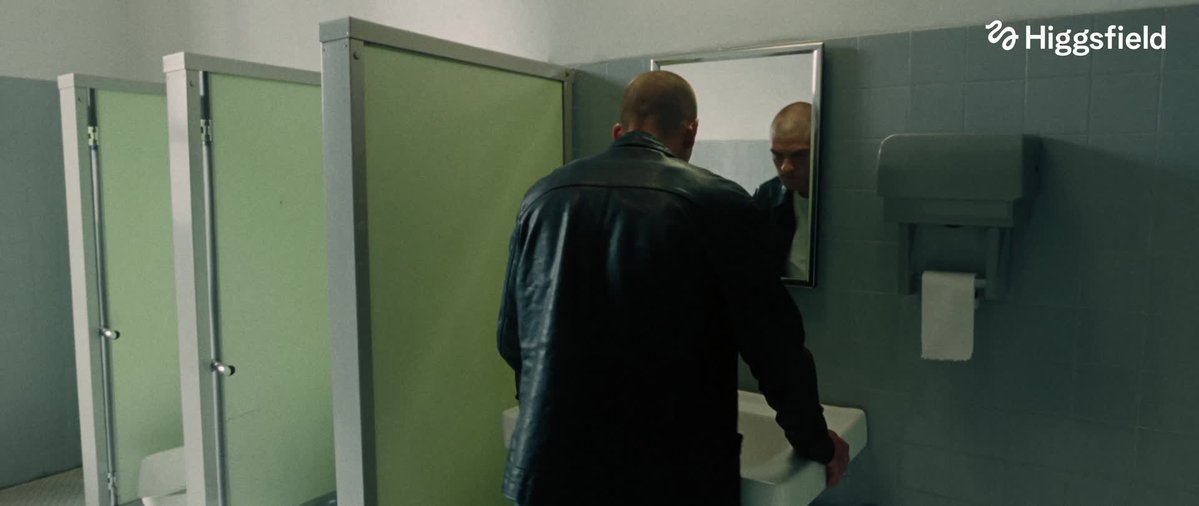
The third makes handheld react to something. The mirror scene places the operator at 60cm to 1.2 metres from the actor, retreating when he lunges and lowering with his hand. The camera changes direction because of action or gaze, never on a timetable. The movement follows the performance, not a preset orbit.
The fourth describes where the weight goes. The dog is about 22kg. The prompt specifies bent knees, a two-arm lift, weight pulling the shoulders down, and a sidecar that sinks then rocks back. For any lift or landing, write the contact sequence and what moves under load.
The fifth gives stillness instructions. The butterfly mostly rests with open wings. Antennae move, legs occasionally step, and the wings close, pause and reopen. Constant flapping is ruled out.
The sixth puts a complex close-up on a timeline. The five-second eye shot runs 0 to 1.2 seconds with lids nearly shut, 1.2 to 3 seconds as the opening reveals the iris, and 3 to 5 seconds as the pupil constricts. Locked macro, focus on the iris, no extra blink.
The seventh writes continuity rules for small details. The robot prompt fixes sticker positions, a bandaged forearm, and one lens-eye with no mouth. Its drop is only 30cm, followed by a slide down the wall, with no flips or bouncing. Specify the path, not just the destination.
What was not said
The posts do not name the model used for the commercial. That matters, because prompts this detailed behave differently across engines. A negative clause that one model respects, another may ignore or even treat as a cue.
There are no success rates, no count of rejected takes and no cost per finished shot. One commercial is an anecdote, not a benchmark. We also cannot see how many attempts it took to land the eye macro or the 22kg lift, so treat the wording as a strong starting point, not a guarantee.
Higgsfield also points to a full project brief with scene prompts, reference assets and production notes, and promotes its Higgsfield MCP, which brings the workflow into an AI assistant. No pricing or availability details for the MCP were given in these posts.
What to test first
Start with the reference-roles rule on a scene you already know is fragile. Label each input with a single job, then add one line saying what must not carry over. Run it against your current prompt on the same seed or settings if the tool allows.
Next, rewrite one handheld shot so the camera answers to the actor instead of orbiting. Then take your worst continuity problem, a prop, a bandage, a logo position, and fix it in writing before you generate.
The common thread is cheap to adopt. It costs you a few extra sentences per shot, and the specificity will show on screen.
Sources: the reference-roles rule, the parallax rule, the mirror scene camera positions, the handheld prompt, the weight rule, the train scene references, the eye timeline, the stillness rule, the continuity rule, the MCP post, the project brief link.