OpenAI's GPT-6 Astra is now driving Higgsfield's 3D production pipeline, and it gives AI filmmakers a single-prompt path from concept to rendered scene
GPT-6 Astra, OpenAI's new flagship model, is already powering end-to-end 3D filmmaking inside Higgsfield Supercomputer, turning floor plans into walkthrough renders, blocking seven-room shots, and writing playable games from one sentence.
OpenAI dropped GPT-6 Astra on 3 September 2026, and within hours Higgsfield had already wired it into a production pipeline that no filmmaker had access to the day before. The headline claim from OpenAI is sweeping: Astra sets a new state of the art for computer use, software engineering, science and professional work, and it is rolling out today to ChatGPT Plus, Pro, Business and Enterprise users, as well as through the API and AWS. For most people that means a better chatbot. For AI filmmakers working inside Higgsfield's ecosystem, it means something more specific and more immediately useful.
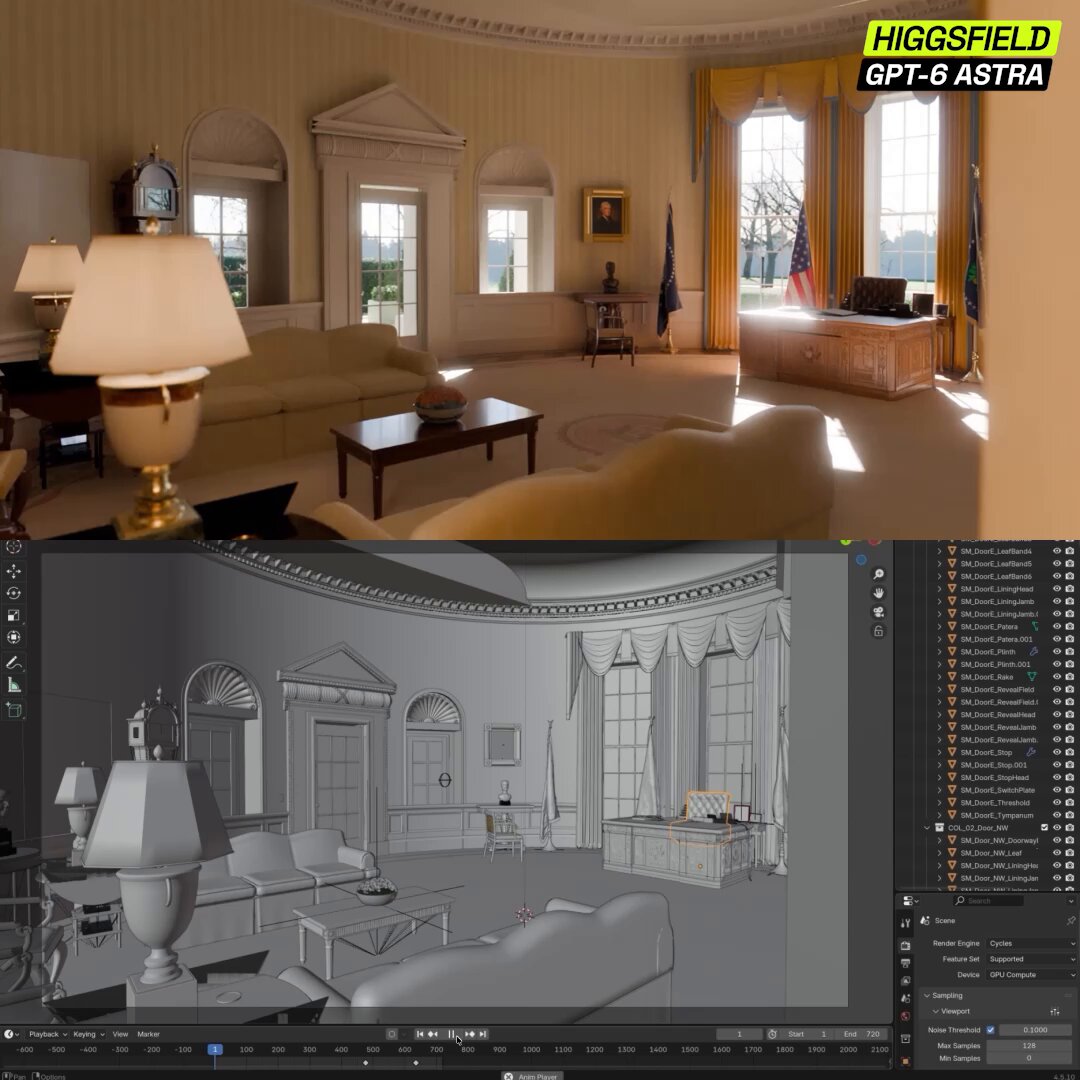
@higgsfield_ai published a sequence of demos on the same day showing exactly what that pipeline looks like in practice. In the most striking example, a single floor plan fed to Astra produced a fully furnished, ray-traced 3D walkthrough: Astra reconstructed the layout in Blender, placed the furniture, set the natural lighting, and rendered the tour end to end on Higgsfield Supercomputer. A separate demo showed a continuous shot moving through seven rooms without a cut, with Astra handling all spatial mapping and blocking before Seedance 2.5 rendered the result. Another had Astra vibe-coding the Oval Office in 3D from a written set description, generating the scene code, which Higgsfield then built as a location model in Blender and rendered with Cycles. A fourth produced a playable FPS and a full browser-running arcade racer, Street Heat, from a single descriptive sentence.
What the pipeline actually looks like
The workflow Higgsfield is demonstrating has a consistent shape: a text or image input goes to GPT-6 Astra, which handles the spatial reasoning, layout reconstruction, code generation or shot-list construction; Higgsfield Supercomputer then takes that output into Blender for geometry, lighting and rendering, with Seedance 2.5 handling the video generation step where motion is required. The phone-linked handheld demo added a live Blender viewport link, so a camera move captured on a phone maps directly to the render without re-prompting.
For working filmmakers this matters most at the pre-visualisation and location-building stages. Building a Blender scene from scratch to check blocking or spatial logic takes hours; doing it from a floor plan or a written description in one pass is genuinely different in kind. The seven-room continuous shot demo is the clearest proof of the spatial reasoning claim: maintaining camera blocking coherently across seven rooms, without cuts, is a hard constraint problem that previous models handled poorly.
What was not said
Higgsfield's demos are impressive as demonstrations, but several important questions are unanswered. No generation times are published for any of the 3D pipeline runs, so it is not possible to know whether the floor-plan-to-walkthrough pass takes minutes or hours. The Blender output quality in the Oval Office and walkthrough demos looks clean in the posted thumbnails, but no raw Blender files or scene statistics are shared, so mesh density, texture fidelity and render settings remain unknown. It is also not clear whether the Higgsfield Supercomputer pipeline is available to all Higgsfield users or is limited to a compute tier not yet publicly priced.
On the Astra side, OpenAI states it is rolling out to all ChatGPT Plus and Pro users over the coming days, and it is accessible via API and AWS. No specific pricing for API access to Astra is announced in the posts. OpenAI's benchmark claims, including state-of-the-art results on FrontierMath Tier 4, ARC-AGI 3, TerminalBench-4.0, Terminal-Bench Science 0.1 and HealthBench Pro, are benchmark scores, not production performance guarantees. Benchmarks are not workflows.
The comparison tests Higgsfield ran
Higgsfield also published a set of direct comparisons between GPT-6 Astra and Fable 5.1 across three stylistic challenges: a hand-drawn Japanese ghost story, a paper-craft kabuki sequence, and a museum shoot involving cast and shot-list management. Both outputs in each test were rendered with Higgsfield Seedance 2.5, which isolates the language model's contribution to layout, blocking and direction. The results are not quantified beyond the side-by-side, and the framing is Higgsfield's own, so treat these as illustrative rather than independent benchmarks.
What to test first
If you have ChatGPT Pro access and a Higgsfield account, the most immediately testable part of this pipeline is the spatial-reasoning input stage: describe a location in prose or feed in a rough floor plan and ask Astra to generate scene code or a shot list before you open Blender at all. That step is free to attempt and directly replaces the most time-consuming part of pre-visualisation for filmmakers working without an art department.
The handheld phone-to-viewport live link is the most unusual capability shown and the one with the least information attached to it. Worth flagging to Higgsfield support to ask what hardware and account tier it requires before building a workflow around it.
The bottom line is that GPT-6 Astra's computer-use and spatial-reasoning capabilities are now plumbed into a production-ready 3D render pipeline, and Higgsfield moved fast enough to show that in working demos on launch day. Whether that pipeline is accessible, affordable and fast enough for your project is still an open question, but the direction of travel is clear.