FlovaAI has added Wan 3.0 as a head-to-head comparison option against Seedance 2.5 and MiniMax H3, starting at $0.013 per second
FlovaAI has quietly become a live comparison arena for the three most-discussed video models right now. Wan 3.0 is now available on the platform alongside Seedance 2.5 and MiniMax H3, with per-second pricing that makes short tests genuinely cheap.
Wan 3.0 is spreading across platforms at a pace that is starting to feel relentless, and FlovaAI is the latest to land it. Per multiple creators posting side-by-side comparisons this week, Wan 3.0 is now live on FlovaAI alongside Seedance 2.5 and MiniMax H3, billed at $0.013 per second of generated video. That puts a five-second clip at roughly six cents and a 30-second generation at under 40 cents, making the cost of running a quick comparison between models essentially trivial.
What makes the FlovaAI launch worth paying attention to is the framing the platform appears to be leaning into: not just access to a model, but a side-by-side arena where you generate the same prompt through two models and decide which version you prefer before committing to a longer sequence. Per creator @SaniAiTech and @Chaemate_, the Wan 3.0 versus MiniMax H3 test centres on audio-video synchronisation and transition naturalness, two areas where model differences tend to surface most visibly in short narrative clips. Per @Just_sharon7 and @AIwithJessica, a Viking sea battle prompt was used to compare Wan 3.0 directly against Seedance 2.5 on the same dramatic subject matter.
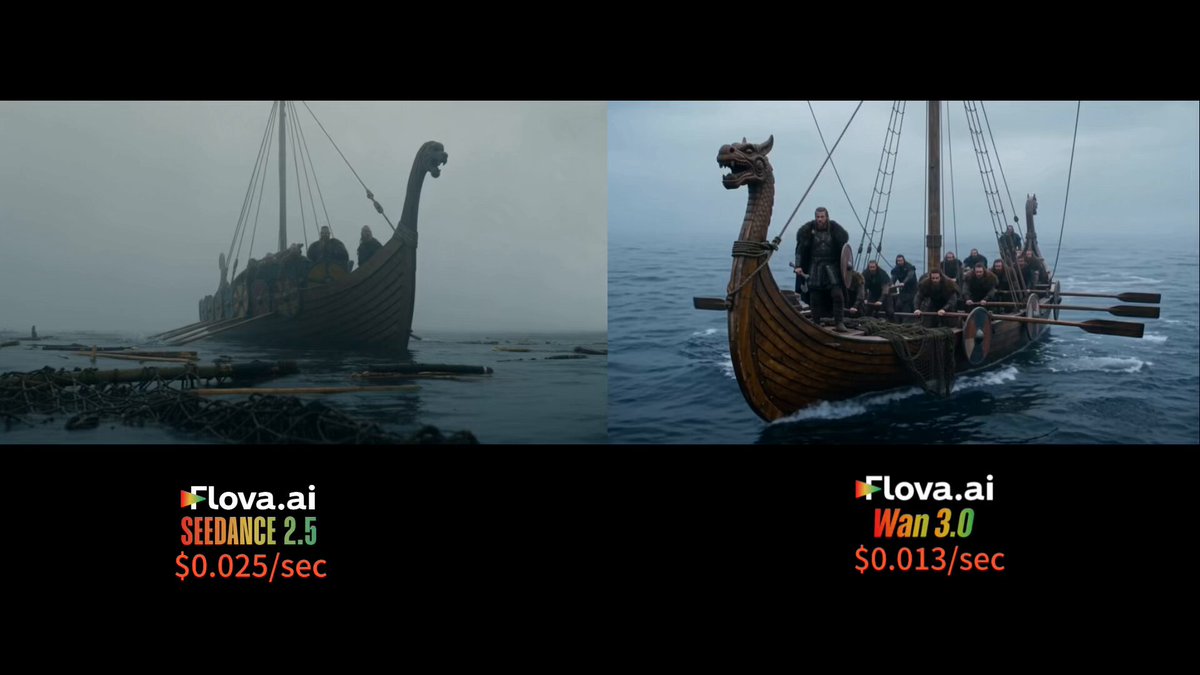
What the comparisons are actually testing
The clips shared publicly focus on transformation sequences and high-motion action shots, both of which stress-test a model's ability to hold coherent motion across frames. Wan 3.0's native audio-video synchronisation, baked into the model rather than bolted on in post, is cited repeatedly as the differentiator in the Flova tests. MiniMax H3 and Seedance 2.5 are strong models in their own right, and neither has been declared a loser here. The creators posting these comparisons are asking viewers to judge for themselves, which is exactly the right approach given how much prompt wording and generation seed can swing results between runs.
What has not been said
FlovaAI has not, as far as these posts show, made a formal announcement confirming all three models are permanently available or whether any are in a limited beta window. The $0.013 per second figure appears in the posts but no breakdown has been given for whether that rate applies uniformly across resolution tiers or clip lengths. There is no stated cap on generation duration, so whether FlovaAI supports Wan 3.0's native 30-second single-pass generation or clips it shorter remains unclear. Pricing could also change once any introductory period ends. No date for a formal platform announcement has been shared.
How this sits against the alternatives
Wan 3.0 has already landed on Runway, ComfyUI, TopviewAI, YouArt, Pollo, Magnific and GlobalGPT in recent days. What FlovaAI adds is the comparison-native workflow: most platforms present one model at a time and leave the filmmaker to manually re-prompt elsewhere to compare. A platform that holds both outputs on screen simultaneously, at per-second pricing low enough to burn through a dozen test pairs without noticing the cost, is a genuinely different working environment. Whether the interface actually delivers that experience in practice is something only hands-on testing will confirm.
What to test first
If you are already in a Wan 3.0 workflow and want a quick read on FlovaAI's value, the most useful first test is a prompt you have already run somewhere else. Bring a known prompt, run it through Wan 3.0 on FlovaAI, and compare the result against your existing output before spending time on the platform's comparison feature itself. The $0.013 per second rate means a five-clip exploratory session costs well under two dollars. The audio-video sync behaviour is worth listening to carefully rather than just watching, since that is the specific capability the creators in these posts are highlighting as Wan 3.0's edge on this platform.