Fal's H3 Max Turbo runs at twice the speed for half the cost, and it gives AI filmmakers the most affordable high-quality video generation on the market right now
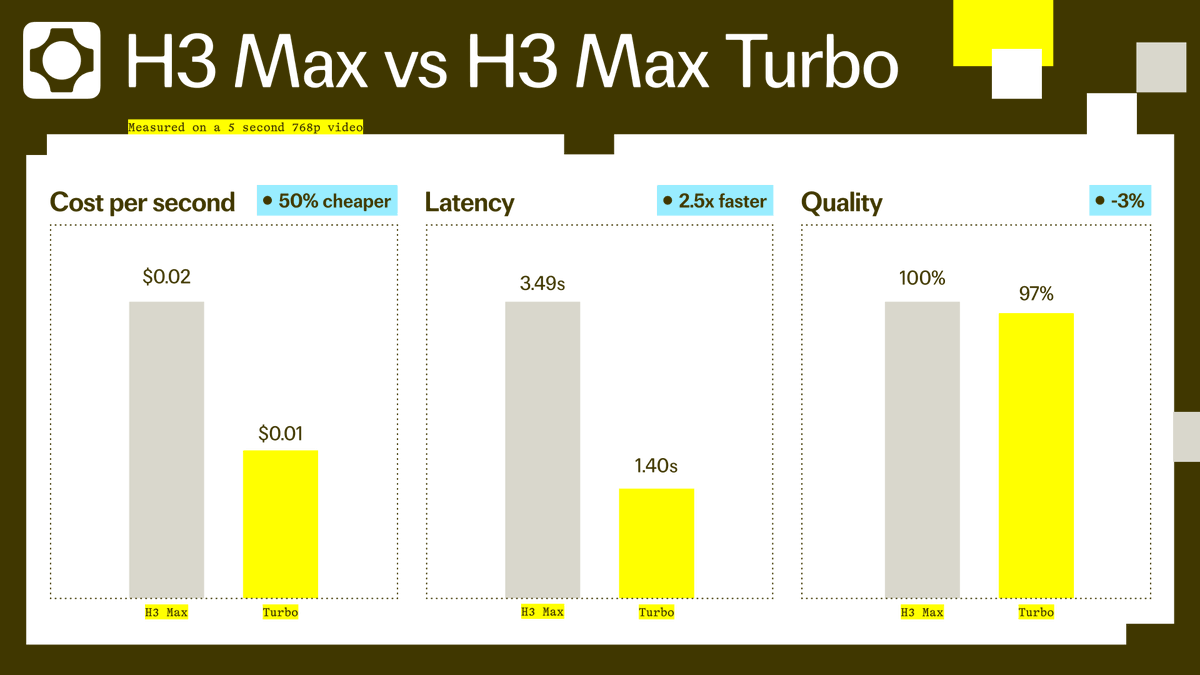
Fal has launched H3 Max Turbo, a faster and cheaper variant of H3 Max that generates 768p video at $0.01 per second at promotional pricing, while targeting the 97th percentile of the original model's quality.
Speed and cost have always been the two variables that determine whether an AI video tool actually enters a working pipeline or stays as a novelty. Fal just moved both needles at once. H3 Max Turbo, announced on 2 September, runs at twice the speed of H3 Max and at half the cost, with a promotional price of $0.01 per second of 768p output. That is not a rounding-error discount. At that rate, a five-second clip costs five cents. A thirty-second sequence costs thirty cents. Suddenly the economics of iterating on a single scene start to resemble the economics of pressing render a few extra times, not the economics of deciding whether a shot is worth pursuing.
The framing from @fal is precise and worth taking at face value: Turbo targets the 97th percentile of the original H3 Max's quality on their internal evaluations, while still outperforming H3 and, per the announcement, any other video model at that tier. That is a careful claim. It does not say Turbo matches Max at everything. It says Turbo is better than everything except the top three percent of what Max produces. For most production shots, that gap will be invisible. For the rare hero shot where you need absolute ceiling quality, you now know which variant to reach for and which to skip.
What this actually changes in a real pipeline
The practical shift is about iteration budget. At the old H3 Max price point, a filmmaker generating multiple takes of the same scene to find the best version was making an economic decision each time. At $0.01 per second, that decision largely disappears. You can afford to generate eight versions of a five-second shot for forty cents, compare them, and discard six. That is how a more deliberate creative process works, and it has historically been unavailable at AI video quality levels.
Generation time dropping by half also matters independently of cost. If H3 Max was taking, say, forty seconds of wall time to produce five seconds of video, Turbo is producing the same output in roughly twenty. Across a session where you are generating dozens of clips, that adds up to meaningful time back in the day. It also tightens the feedback loop, which consistently produces better creative decisions.
How it sits against the current field
The $0.01 per second figure at 768p is currently the most aggressive pricing from any major API-accessible high-quality video model. Seedance 2.5, for reference, was covered here at $0.025 per second during Flova's 818 sale, which was itself notable for being cheap. H3 Max Turbo at promotional pricing undercuts that by sixty percent. The promotional caveat matters, and no end date for that pricing has been announced. Treat it as the current rate, not a guaranteed permanent one.
Fal's positioning of H3 Max Turbo as better than H3 Max and every other competing model except the top percentile of Max itself is an assertive benchmark claim. Their evals are internal. Independent head-to-head testing on specific shot types, particularly the ones AI video still struggles with, such as fluid hand motion, consistent faces across cuts, and complex dynamic lighting, has not yet been published by third parties. What creators test and share in the coming days will be the more useful signal.
What was not said
No information has been given on the long-term pricing after the promotional period ends. There is no announced timeline for when Turbo exits preview. The announcement does not specify resolutions beyond 768p or whether longer clip lengths at higher resolutions carry different pricing. The claim of outperforming all other models is based on fal's own evals, which are not publicly detailed. These are the numbers to watch as independent creators put footage through both variants side by side.
Where to start
Fal has made both text-to-video and image-to-video endpoints live. The most useful first test is a shot you have already generated with H3 Max, or with a competing model at a price point you found acceptable. Run the same prompt through H3 Max Turbo and compare the output directly. If the quality is indistinguishable to your eye at the resolution you actually deliver at, Turbo becomes your default and Max becomes the reserve for specific high-stakes shots. That is a workflow decision you can make in one session, and at a cent per second, the test itself costs almost nothing.
For AI filmmakers managing credit budgets across a project, the ability to run exploratory generation at this price point without strategic rationing is genuinely new. Use that freedom to test more aggressively early in a project, when iteration is cheap, and save the ceiling-quality runs for locked shots.