Fal's post-trained H3 Max hits number one on the video leaderboards and generates a five-second clip in under three seconds
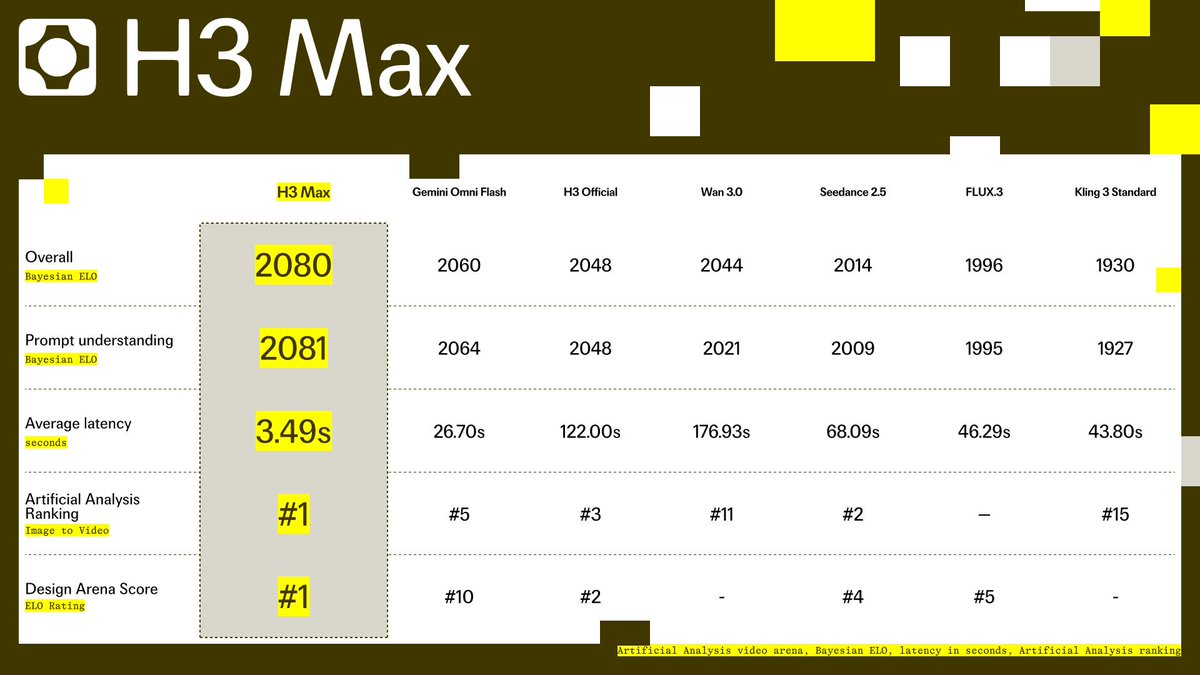
Fal Research has released H3 Max, a post-trained version of MiniMax H3 that ranks first for overall quality, prompt understanding and aesthetics against twelve leading models, while delivering roughly 35 times the throughput of the official H3 endpoint.
The race for the fastest, sharpest video model just moved. @fal has released H3 Max, a post-trained derivative of MiniMax H3 developed by fal Research, and the numbers are striking enough to deserve attention from anyone who generates video at scale. A five-second, 720p clip renders in under three seconds. That is not a benchmark cherry-picked under ideal load, it is approximately 35 times the throughput fal reports against the official MiniMax H3 endpoint, and faster than every other model in their own comparison set.
On the Artificial Analysis Video Leaderboards, H3 Max debuted at number one in Image-to-Video and number three in Text-to-Video. Design Arena, which runs independent preference evaluations, describes it as setting a new Pareto frontier for video generation: no other Image-to-Video model on their arena delivered higher preference at a lower generation time. Their figures put Image-to-Video generation time at 6.4 seconds and Text-to-Video at 4.7 seconds, 18 times and 24 times faster than the respective averages on that platform.
What fal actually did
H3 Max is not a new base model. It is a post-training pass on MiniMax H3, co-optimised with fal's custom inference stack. Fal describes the tuning as targeting stronger prompt adherence and better aesthetics, two dimensions where the base H3 was already competitive but not dominant. The inference optimisation is inseparable from the quality result: the two were developed together rather than bolted onto an existing checkpoint, which is why the speed improvement is so large relative to the base endpoint.
Clip length runs from five to fifteen seconds, matching the H3 base capability. Resolution tops out at 720p, which is worth noting if you are building a pipeline that requires native 1080p output. The 480p-to-Topaz upscale workflow many creators are already using with Seedance 2.5 would apply here too.
One correction to note
Fal issued a correction shortly after launch. An early graphic in the announcement thread showed Artificial Analysis rankings for several comparison models that turned out to be inaccurate. The corrected figures placed Gemini Omni Flash at fourth, with Wan 3.0, Seedance 2.5 and FLUX.3 listed as unranked, and Kling 3 Pro at fourteenth. H3 Max's own ranking of first in Image-to-Video and third in Text-to-Video was not revised. The correction is worth keeping in mind when reading the comparison tables: the relative position of H3 Max appears solid, but the gap to specific named competitors is harder to pin down than the original graphic suggested.
Pricing and availability
H3 Max is live now on fal. For the first week from launch it is 50% off, which fal frames as making it simultaneously the highest-quality, fastest and cheapest option for general video generation tasks. No specific per-second or per-clip pricing was included in the announcement, so the discount landing price requires checking directly at fal.ai. Whether the 50% promotional rate extends, becomes permanent or reverts after the week is not stated.
What this means for a working pipeline
The speed figure is the most immediately practical thing here. Sub-three-second generation for a five-second clip means iteration loops that previously took minutes of waiting compress to near-instant feedback. If you are testing prompt variations, comparing camera moves or running A/B selects before committing to a full scene, that throughput change is real and compounding across a session.
The number-one ranking in Image-to-Video is the other flag. I2V is where most narrative AI filmmakers live, because locking a character or environment from a reference frame is the foundation of any shot-consistent workflow. If H3 Max holds its preference scores in independent testing over the coming days, it becomes the serious alternative to Seedance 2.5 and Wan 3.0 for that use case, with a speed profile neither of those currently matches at this quality tier.
What is still unknown: how H3 Max performs on longer clips approaching the fifteen-second ceiling, whether the aesthetic improvements extend to complex multi-element scenes or mainly shine on simpler compositions, and how its character consistency holds across cuts compared to models specifically tuned for that. Fal's own benchmarks are first-party, and while Artificial Analysis and Design Arena are independent, community testing over the next week will be more telling than any single leaderboard snapshot.
Test it first on Image-to-Video tasks where you currently use H3 base or Seedance 2.5. The speed alone justifies the experiment, and this week's discount removes the cost argument for trying.
---
Sources: fal announcement, speed benchmark post, Artificial Analysis leaderboard post, fal benchmark vs 12 models, ranking correction, Design Arena post, Artificial Analysis independent confirmation