Dreamina has announced an Emmy-winning jury for its Seedance 2.5 3D Reference Contest, and CapCut's Wave 2 challenge adds an $80,000 prize for filmmakers who push further
Dreamina's Seedance 2.5 creative contest now has a formal jury including two Emmy Award-winning directors, while CapCut's Wave 2 continuation challenge offers an $80,000 prize pool for multi-scene storytelling built entirely inside CapCut PC. Both competitions share a deadline window closing in early September.
Two competitions running simultaneously on ByteDance's AI video stack just got considerably more serious. Dreamina has formally named the jury for its Seedance 2.5 3D Reference Creative Contest, and the panel is not made up of social media influencers or brand ambassadors. It is four people who have actually built things: two Emmy Award-winning directors, a rendering specialist with fifteen years of photorealistic production experience, and a working 3D artist and AI creator. That raises the stakes for anyone sitting on a Seedance 2.5 project and wondering whether to bother entering.
At the same time, CapCut's Wave 2 challenge has put $80,000 on the table for filmmakers who can build a three-minute-or-longer story using Seedance 2.5 inside CapCut PC's multi-track timeline, with submissions closing on 6 September. The two competitions run on the same underlying model, which means the same generation budget and prompt discipline apply to both. If you are going to test Seedance 2.5's 3D reference or scene-continuity capabilities anyway, you may as well be pointing at a prize.
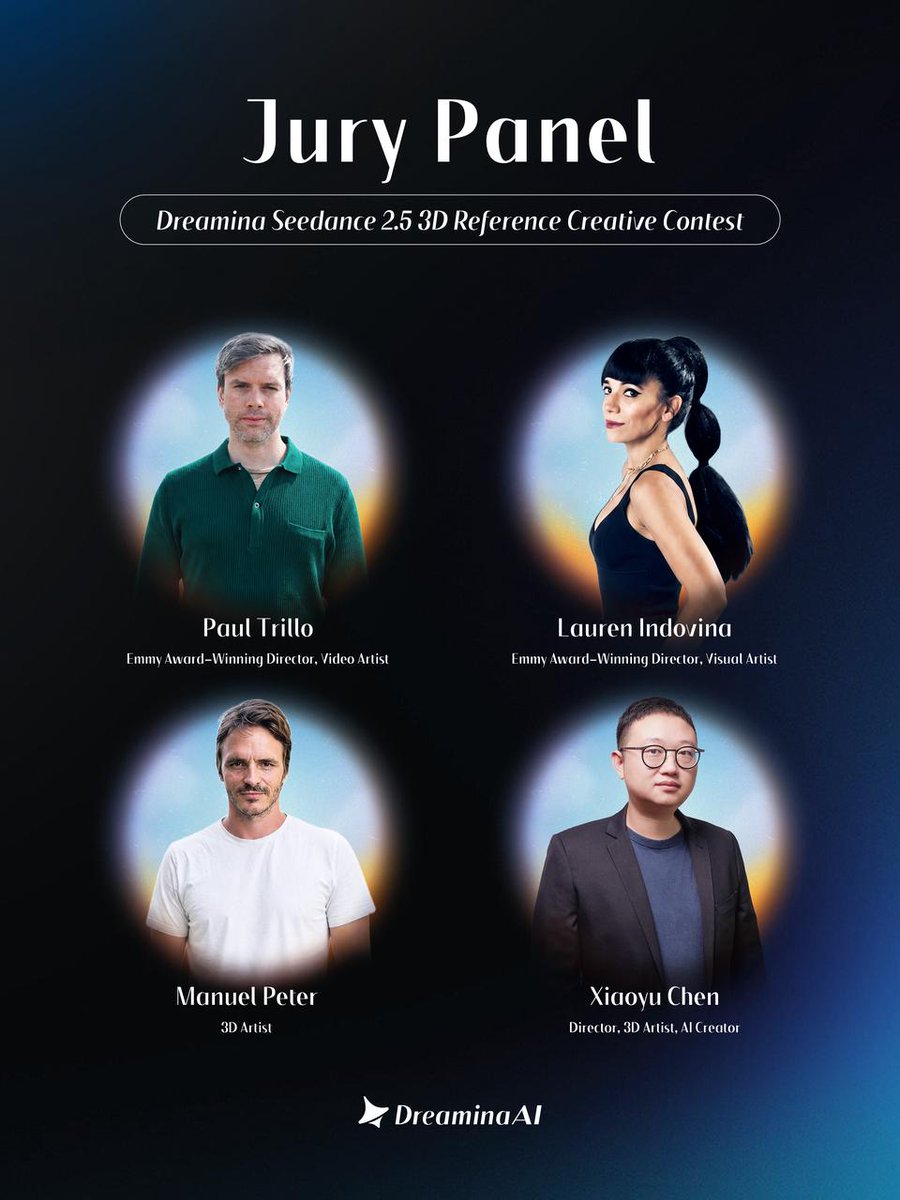
Who is judging the Dreamina contest
Per @dreamina_ai, the jury comprises:
- Paul Trillo: Emmy Award-winning director and AI imaging pioneer
- Lauren Indovina: Emmy Award-winning director and MoMA permanent collection artist
- Manuel Peter (Pwnisher): Top-five finisher in Pwnisher Challenges and a rendering specialist with over fifteen years of photorealistic production credits
- Xiaoyu Chen: Director, 3D artist and AI creator
Two of the four judges come from broadcast television with Emmy hardware. One comes from the CGI rendering community where technical precision is assessed with genuine rigour. That composition matters: it tells you the judging framework will weigh cinematic intent alongside technical execution. A technically clean render with no narrative purpose will probably not win. A bold concept with muddy geometry probably will not either.
What the CapCut Wave 2 challenge asks for
Per @LearnWithBishal, all Wave 2 entrants start from a shared first frame, then diverge. The brief is to build a three-minute-or-longer story using CapCut PC's multi-track timeline, exporting a finished edit that demonstrates scene continuity through Seedance 2.5. The $80,000 prize pool is split across the pool of winners, with submissions closing 6 September.
The single-shared-frame constraint is the interesting creative wrinkle. It means judges can isolate directorial choices from prompt quality at the opening shot, since everyone begins identically. What you do from frame two onwards is entirely yours.
Pricing context and free entry window
Dreamina is currently running a promotion: four free, queue-free Seedance 2.5 generations for new users, valid for three days from the promotion launch on 13 August. Paid usage starts at $0.097 per second of output. At that rate, a 15-second clip costs roughly $1.46. Generating the material for a three-minute CapCut submission from scratch, assuming a mix of successful and discarded takes, realistically runs to somewhere between $15 and $40 depending on iteration discipline. That is not nothing, but it is not a barrier to entry for anyone who has spent money on AI video tools before.
Native 1080p output on Dreamina's Seedance 2.5 integration is also confirmed live, per @BytePlusGlobal, with 10-bit colour and what the company describes as richer textures and more natural skin tones. That matters specifically for the contest: if judges are evaluating on a large screen, 720p artefacts become visible fast.
What is not confirmed
No prize breakdown for the Dreamina 3D Reference Contest has been published. No submission deadline for that contest has been confirmed in the posts reviewed. The CapCut Wave 2 deadline (6 September) is the only hard date available across both competitions. It is also not clear whether entries to one disqualify entries to the other, since both run on Seedance 2.5 but on different platforms.
What to do if you are making AI video
The Dreamina jury composition is a signal worth reading. Paul Trillo and Lauren Indovina are the kind of judges who will notice if a shot has a reason to exist. Prompt crafting for the 3D Reference category should probably start with a clear visual argument, not just an aesthetically pleasing scene. Manuel Peter's presence on the panel means geometry and material quality will be scrutinised: if your 3D reference integration produces swimming textures or incorrect light interaction, that will be noticed.
For the CapCut challenge, the three-minute minimum is a floor, not a target. Tighter editing on a focused premise will outperform a padded compilation of impressive individual clips. The multi-track timeline inside CapCut PC is the tool that makes scene transitions and audio sync manageable at that length without switching platforms.
Both competitions close within weeks. If you have been waiting for a reason to stress-test Seedance 2.5's consistency across multiple generations, there are now two prize pools attached to that exercise.