Seedance 2.5 is officially out, and it makes 30-second AI videos in one go
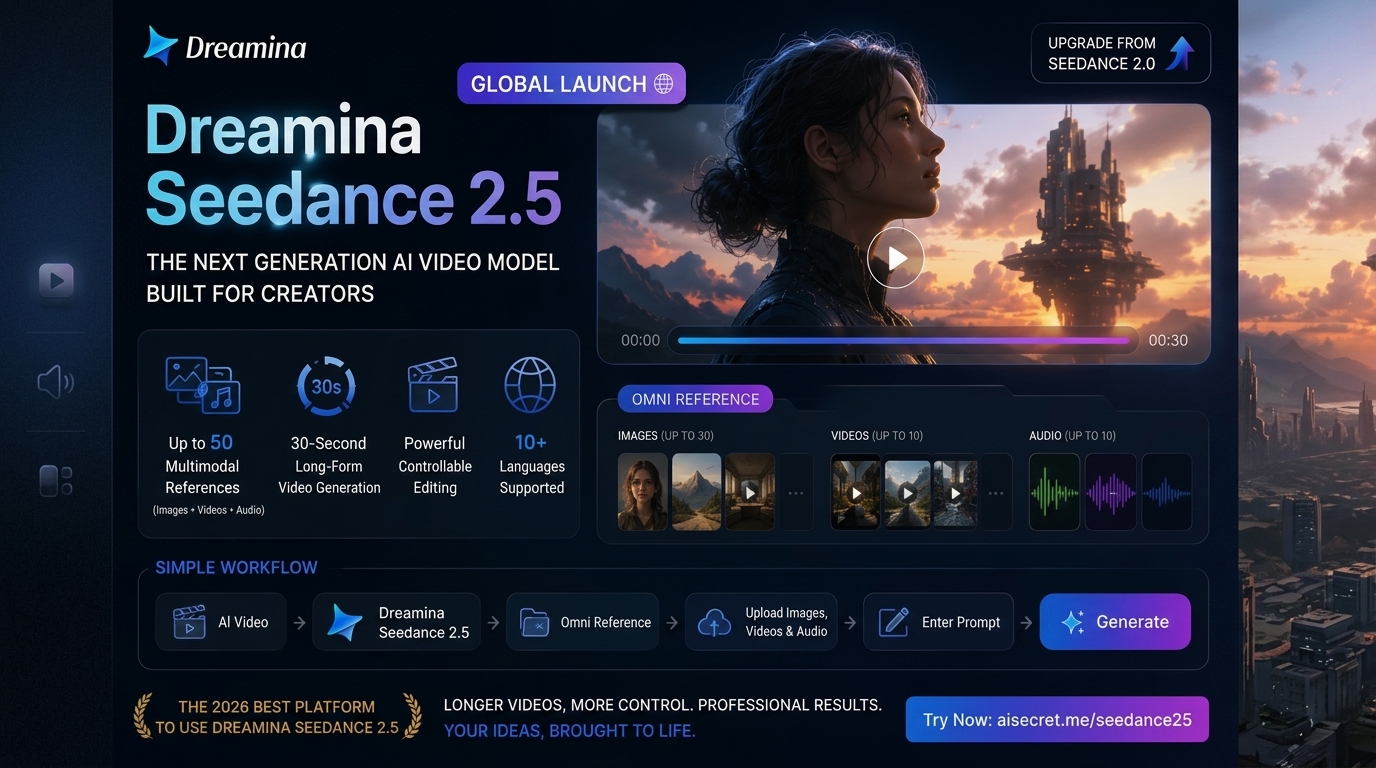
ByteDance's Dreamina has launched the next generation of Seedance, per creator reports: 30-second generation, multimodal references and new editing tools.
The most anticipated model upgrade of the summer has stopped being a rumour. ByteDance's Dreamina has launched Seedance 2.5, according to creator @manishkumar_dev, and the spec list reads like a direct answer to everything people push 2.0 past its limits for.
The number that matters most: 30-second generation. Not stitched, not extended in passes, one continuous generation twice the length most working prompts are built around today. Alongside it, per the same report: multimodal references, so you can anchor a generation to more kinds of input at once, and a set of editing tools aimed at fixing shots rather than regenerating them.
The honest caveats. This is a creator report rather than a press release we have independently verified, and launch-day spec lists always describe the best case. Thirty seconds of generation is not thirty seconds of usable footage until real projects say so, and Dreamina's pricing for the long generations will decide how much of this power people actually use.
What thirty seconds changes about how you write prompts
Everything about current prompt craft assumes scarcity of time. Five, eight, ten seconds forces you to pick one action and protect it, which is why the best prompts in circulation are ruthless about a single beat and why timed-beat notation caught on at all. Thirty seconds inverts the constraint. You are no longer choosing which moment survives, you are directing a sequence, and that is a different skill: pacing, when to hold a shot, when to move the camera, how to get from one beat to the next without the model losing the thread halfway.
Expect a lot of thirty-second generations that would have been better at eight. Length is an invitation to ramble, and models drift the further they run from their opening instruction. The prompts that will work are the ones that treat the extra duration as structure rather than space: explicit beats with timings, one continuous intention, and a clear reason for every second that is not doing anything.
Editing tools are the underrated half
The repair tooling deserves more attention than the headline number. The dominant cost in AI video production right now is not generation, it is the reroll: a shot that is 90 percent right, one hand wrong, and no way to fix that hand without regenerating everything and losing the 90 percent you liked. If Dreamina's editing tools genuinely let you address a region and keep the rest, the economics of a shoot change, because your best takes stop being disposable.
That is also the claim most likely to be oversold. Region editing that preserves temporal consistency across a moving shot is hard, and the demo version of this feature is usually a still frame.
Against what you are running now
If you work in Seedance already, your existing prompts carry over and the ceiling moves; that is the whole story, and it is a good one. If you are on Kling or Veo, the question is narrower: is a longer single take worth changing pipeline for. For most social and ad work, honestly, no. For narrative work, episodic content, or anything where a cut is a compromise rather than a choice, possibly yes.
What to test first
Take one prompt you know intimately at 8 seconds and run it at 30 without changing anything else, then read where it loses the plot. That tells you the real drift horizon rather than the marketed one. Test whether multimodal references hold under length, since consistency degradation usually shows up late in a generation. And put the editing tools against your worst near-miss shot, the one you gave up on, because that is the honest benchmark.
What makes the launch claim easy to believe is the ecosystem behaving as if it is true. Creators are already publishing head-to-head tests of 2.5 against other models, and Higgsfield has spent three days trailing its own upcoming Seedance 2.5 integration. Nobody builds a marketing campaign around a model that does not exist.
Sources: @manishkumar_dev's launch report, with corroborating activity from @hedo_ist and Higgsfield. 1 to 3 August 2026.