Seedance 2.5 is holding child faces, creature flinches and complex physics across a 30-second horror sequence, and creators are documenting exactly what it keeps and what it loses
A growing cluster of filmmakers using Seedance 2.5 across Topview, Krea, Wavespeed, Higgsfield and other platforms are publishing detailed prompt breakdowns and capability notes. The horror-focused work is the most technically revealing, with one creator cataloguing three specific things the model held that most alternatives still drop.
The conversation around Seedance 2.5 has shifted. A week ago it was about whether the model could hold a face across multiple clips. Now, per creator @Kuriyama890, the more interesting question is whether it can hold a face across thirty unbroken seconds when there is almost nothing else happening in the frame.
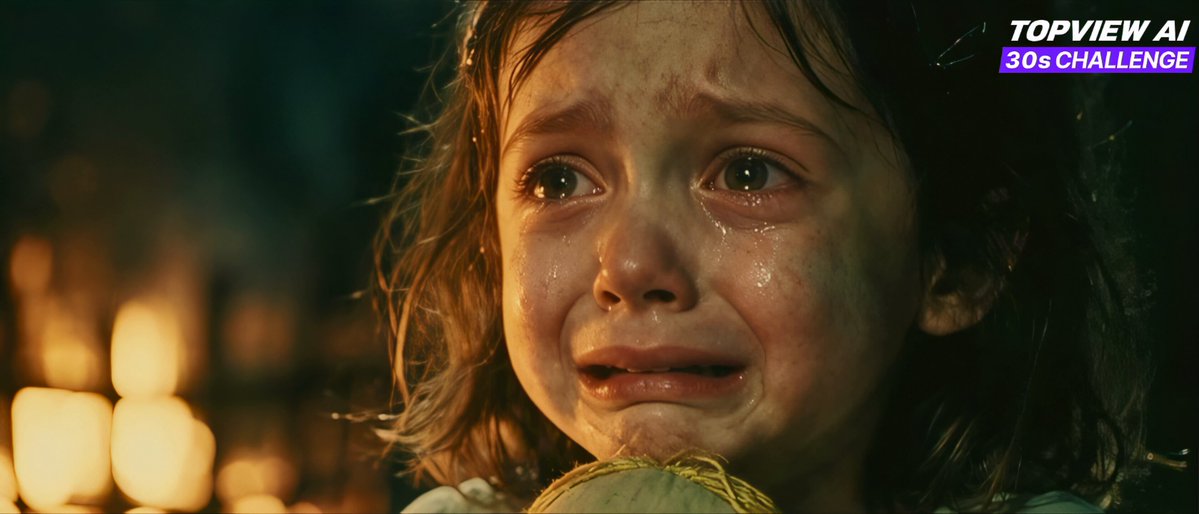
The test case is a short horror piece called Alexandreia Nocturna, generated on Topview and posted with a specific technical debrief. The sequence opens on a small girl crying alone in an empty square. Three things, @Kuriyama890 writes, were not expected to survive the generation: the face itself during a static close-up with no action to distract from drift, a flinch response when a creature enters the scene, and breath timing, with the model holding a caught inhale mid-sob rather than defaulting to steady rhythmic movement. Each of those is a detail that previous models either smoothed away or simply broke.
What the wider cluster shows
The Alexandreia Nocturna test is the sharpest single document, but it sits inside a much larger set of concurrent work. Per creator @awesome_visuals, a bullying intervention scene generated on Krea used Seedance 2.5 to hold emotional escalation across multiple characters in a single continuous shot. Per creator @aymducking, a 30-second single-shot sequence on Topview managed three distinct characters built from seven reference images, with a custom world and AI-generated music added in the same platform. Per creator @doctorwasif, a zombie-on-an-airplane sequence used a structured four-shot prompt to control exactly when body horror details, dark veins, unnatural breathing, the lunge itself, appeared in the timeline.
Across the action and lifestyle end, per creator @luciaverseai, a shopping-mall fight sequence ran through escalators, a cosmetics section and a restaurant using dynamic camera angles and slow-motion near-misses in one generation. Per creator @laviniavelle on itsPolloAI, a dark fantasy battlefield sequence held a consistent character through wide shots and extreme close-ups under a moody sunset sky. Per creator @aiwithaly, a hotel-room thriller generated on a structured timeline prompt held a single character from macro close-up to wide escape shot. Per creator @Itswsm105f, a 30-second energy drink commercial on Wavespeed delivered product cinematography and dynamic camera movement that several commercial clients have described as usable without further editing.
What this cluster tells a working filmmaker
There is a pattern in the prompts being published. The sequences that hold together best are built on explicit timestamp structures: "Shot 1 (0–1.2s): this, Shot 2 (1.2–2.4s): that." Several creators using this approach, including @doctorwasif and @aiwithaly, are treating Seedance 2.5 less like an image generator that produces motion and more like a single-shot camera system that needs a shot list.
The second pattern is platform diversity. The same model is appearing across Topview, Krea, Wavespeed, Higgsfield, OpenArt, FishCreative, itsPolloAI and SeaArt within a 48-hour window. That breadth matters because pricing and interface vary: creators running short commercial tests at one platform may find a different credit structure elsewhere. Per creator @SyntheSarah, Seedance 2.5 is currently priced at around $0.025 per second on FlovaAI, which puts a 30-second clip at $0.75 before any platform fees.
The third pattern, and the one most worth noting, is the horror-specific performance. Emotional micro-performance, breath, facial muscle tension, involuntary flinching, is exactly the territory where generated video has historically been most embarrassing. @Kuriyama890's note that the model held a chin trembling without action to hide behind is a specific, falsifiable claim, not a promotional caption.
What has not been said
No official benchmark accompanies any of these outputs. These are anecdotal production tests, not controlled evaluations, and consistency will vary with prompt structure, reference image quality and platform-side processing. No creator in this cluster has published failure rates or the number of generations discarded before a usable take. The zombie sequence from @doctorwasif and the horror piece from @Kuriyama890 are compelling, but they represent selected outputs.
Pricing figures quoted by individual creators may also reflect promotional periods or specific platform tiers. Checking current credit rates on the platform you intend to use before committing a long-form project is still necessary.
What to test first
If you are building a short with one sustained performance, try a static close-up with no action in the first three seconds. That is the hardest thing to make a generated model hold, and it is the first thing editors notice when it breaks. Pair the attempt with a timestamp-structured prompt even for a single shot, and note which platform you used, because the variation between Topview, Krea and Higgsfield appears to be real and has not been formally documented yet.