Higgsfield's GPT-6 Astra pipeline is now rebuilding the Seven Wonders of the Ancient World from nothing but written descriptions
Higgsfield is running its GPT-6 Astra plus Seedance 2.5 pipeline through one of the most demanding geometry tests imaginable: reconstructing the Seven Wonders of the Ancient World from ancient text alone. For AI filmmakers, it is the clearest demonstration yet of what description-to-scene production actually looks like at full resolution.
The Hanging Gardens of Babylon were never found. The Temple of Artemis at Ephesus survives only in ancient accounts. The Statue of Zeus at Olympia vanished centuries ago. None of them left behind a blueprint, a photograph, or a scan. What they left was text, and that is precisely the input Higgsfield's GPT-6 Astra pipeline needs.
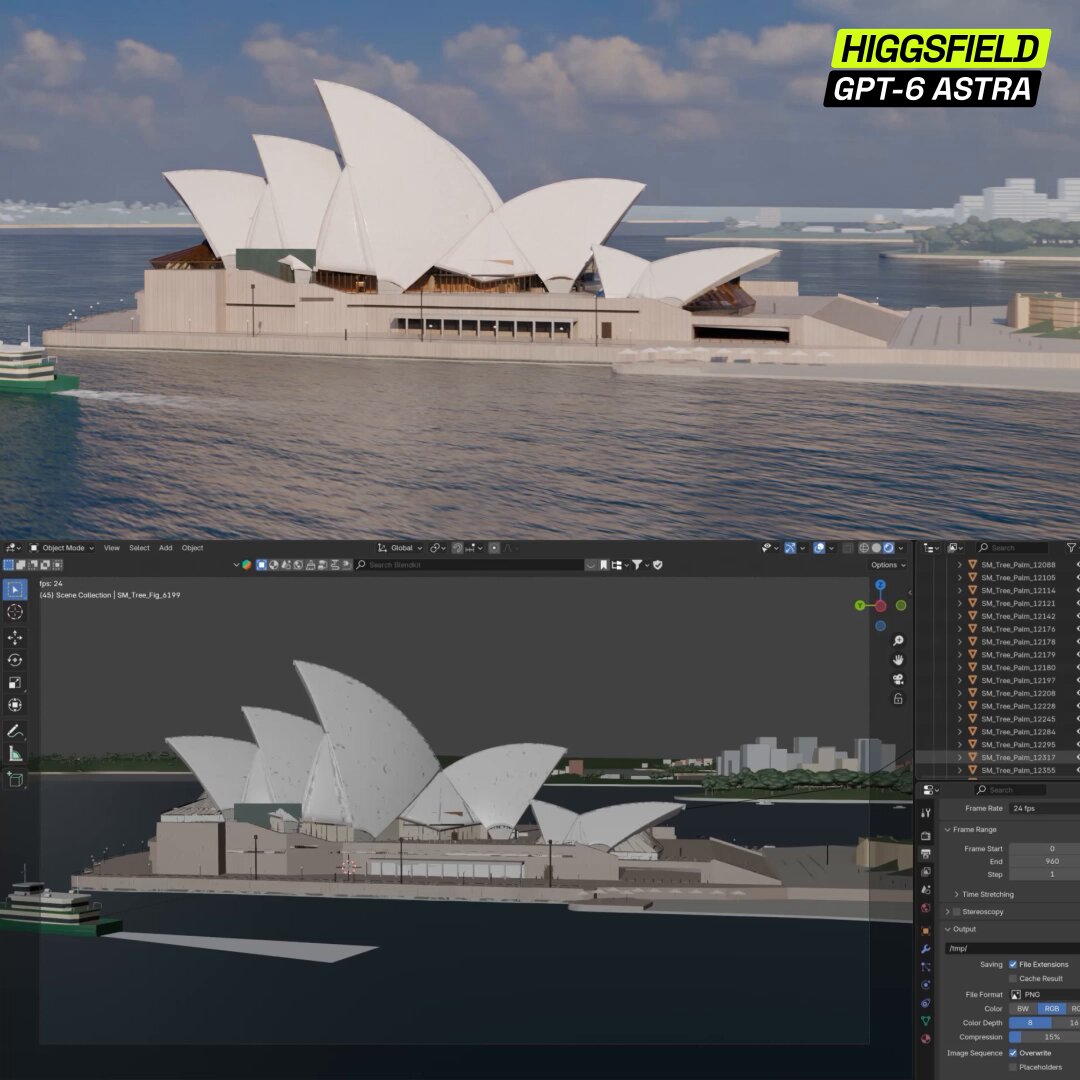
Over the past two days, @higgsfield_ai has posted a rapid sequence of reconstructions under the 3D Jutsu and 3D Genjutsu banners: the Great Pyramid of Giza, the Hanging Gardens, the Temple of Artemis, and the Statue of Zeus, alongside modern landmarks including the Sydney Opera House and a flying Oval Office. In each case, the stated workflow is the same. GPT-6 Astra takes a text description and writes the 3D geometry. Blender gives it clean, editable structure. Cycles handles path-traced lighting. Seedance 2.5 then generates the cinematic final pass. Everything runs on the Higgsfield Supercomputer. The result, across all twelve posts, is film-grade footage of structures that either no longer exist or have never previously been reconstructable by a solo operator in hours.
What the pipeline actually does
The core claim is that GPT-6 Astra writes geometry as code, which Blender then interprets into a real, editable 3D scene. This is meaningfully different from a video model hallucinating a building into a single clip. Because the geometry passes through Blender, a filmmaker can open the file, adjust proportions, shift the camera, change materials, and re-render before the Seedance 2.5 cinematic pass runs. That editability is the workflow difference that matters. A video model gives you one baked output. A geometry-first pipeline gives you a scene you can iterate inside.
The Seven Wonders strand makes this capability concrete in a way that a product demo of a fictional building cannot. There are scholarly reconstructions of these structures to compare against. The Hanging Gardens test is particularly pointed: no agreed archaeological site exists, so the model is working from the same fragmentary classical sources that historians use. Whether it produces architecturally defensible geometry or a plausible-looking confection is a question the posts raise without fully answering. The footage looks compelling. The underlying accuracy is unverified.
What was not said
Higgsfield did not publish the prompts used for the ancient-wonders reconstructions, so the degree of art direction versus raw description-to-geometry is unknown. The posts show finished renders, not intermediate Blender files, which means the editability claim is stated but not demonstrated in the public footage. No timing data appears in any of the posts, though the phrase "hours instead of weeks" surfaces in the context of playable ads built on the same pipeline. Whether that timeline applies to complex architectural geometry is not confirmed.
Pricing for Higgsfield Supercomputer compute is not addressed in any of the posts. Access terms and whether the full Astra-Blender-Seedance stack is available to all users or to a specific tier are not stated. These are the practical questions a filmmaker needs answered before building a production dependency on this workflow.
The playable-ads thread
Running alongside the architectural reconstructions is a separate strand worth noting. @higgsfield_ai posted two demonstrations of GPT-6 Astra generating playable mobile ads from a single prompt, including a walkable recreation of the American Museum of Natural History and interactive fluid-physics web experiences. The museum demo specifically credits DLSS 5 for turning a prototype into something visually finished. This positions the Astra pipeline not only as a filmmaking tool but as a rapid prototyping environment for performance marketing, which suggests Higgsfield is pitching the same underlying stack at multiple buyer types simultaneously.
A direct comparison post shows GPT-6 Astra against Fable 5.1 on the same real-time fluid-physics prompt, with Higgsfield asserting the quality gap is obvious. Competitor comparisons made by a company's own account are not independent benchmarks, and Fable 5.1 was not given a right of reply in any of the posts.
What to test first
For AI filmmakers, the most immediately useful entry point is the modern-landmark strand: the Sydney Opera House reconstruction includes the note that Blender output was "clean, editable geometry", which is the specific thing worth verifying. Load the geometry into your own Blender instance, check whether the mesh is workable, and see how much of the Seedance 2.5 cinematic pass survives a camera angle you did not ask for. The ancient-wonders projects are more spectacular as footage but harder to evaluate without reference geometry to compare against.
The broader shift this batch of posts signals is that Higgsfield is moving its public positioning from video generation toward full scene authorship. Whether the pipeline holds up for complex original environments, and not just well-documented real-world structures, is the question that will determine how far this workflow travels into professional production.
---
Sources: Sydney Opera House reconstruction, Flying Oval Office demo, Great Pyramid of Giza, Fluid physics comparison vs Fable 5.1, Code-based motion design, Temple of Artemis, Statue of Zeus, Playable ads for gaming, Hanging Gardens of Babylon, AMNH playable game, Playable Ads Factory announcement, Motion Videos demo