Higgsfield's Blender plugin locks camera motion before you spend a single credit, and it solves the biggest source of wasted iterations in AI filmmaking
Higgsfield has released a Blender plugin that lets you block out and lock camera movements in 3D before sending anything to the AI generator, cutting the credit burn that comes from iterating on motion blind.
Camera motion has always been where AI video falls apart. Not because the models cannot produce it, but because there is no deterministic way to preview what you will get before the generation runs. You describe a slow push-in, you receive a drift. You ask for a crane sweep, you get something that reads more like a handheld stumble. The only fix, until now, has been to burn credits iterating until something close enough comes back. Higgsfield has decided that is not a workflow, it is a tax.
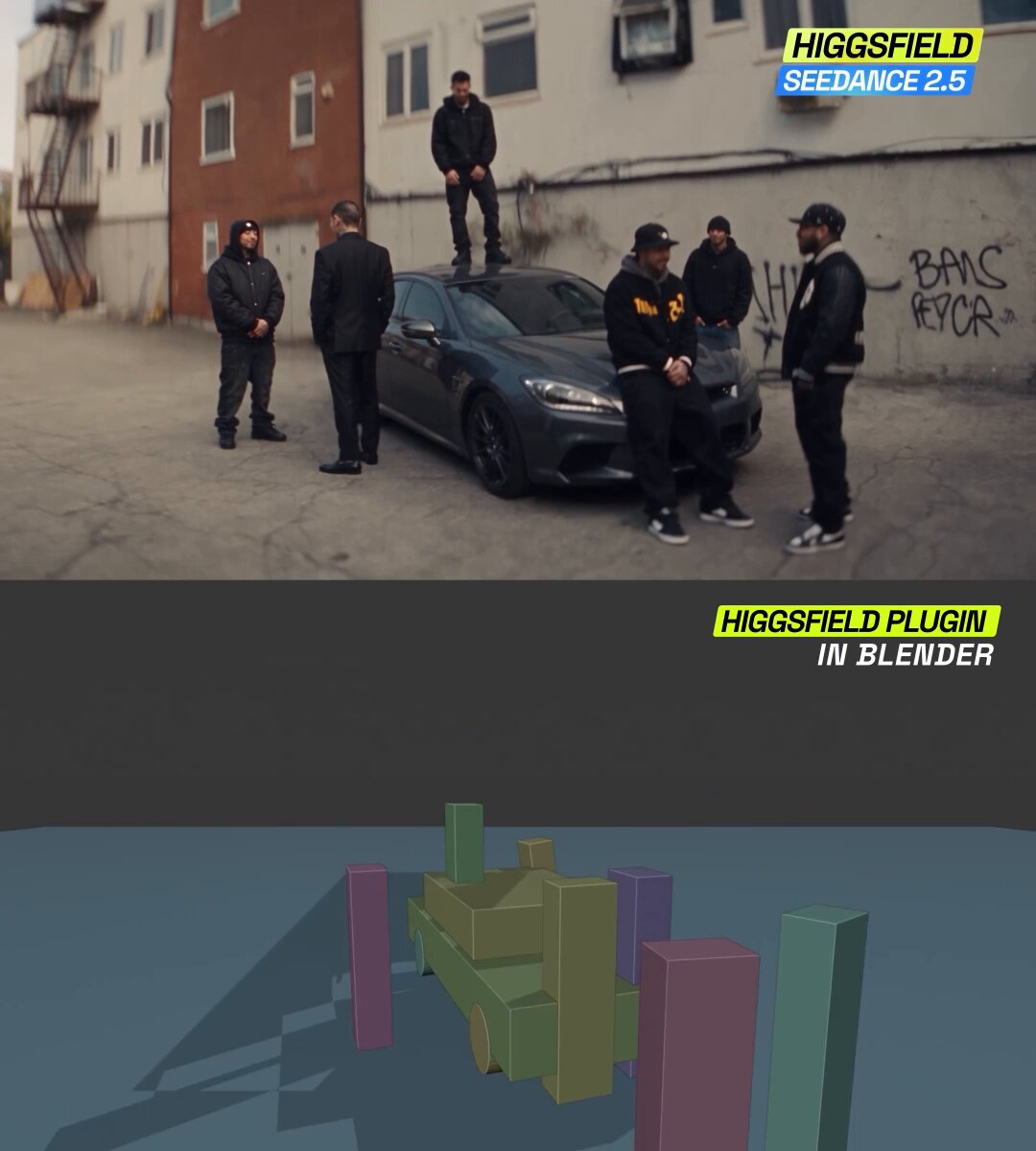
The Blender plugin the company shipped on 29 August changes the premise entirely. You block out your camera path inside Blender, where motion is deterministic, free to preview, and costs nothing to adjust. Once the move is locked, you send it through to Higgsfield and the generator follows it. The promise is precision before spend, which is a different mental model from anything currently baked into the standard text-to-video loop.
What the plugin actually does
The tool sits inside Blender as an integration between its native camera rig system and Higgsfield's generation pipeline. You animate the camera as you would for any conventional 3D pre-vis: set keyframes, scrub the timeline, adjust the arc. That data drives the AI output. Higgsfield has not published a detailed technical spec for how the camera data is translated, whether it uses a depth-map pass, a control signal, or something closer to a ControlNet-style conditioning layer. That detail matters for understanding how faithfully complex moves are preserved, and it is not yet clear.
What the two posts together do confirm is a workflow framing: build the scene in Blender first, lock the motion, then generate. The language is explicit, "stop burning credits on iterations," which suggests the company sees wasted generation spend as a real user pain point it is positioning this tool against.
Where this sits against the current alternatives
The closest thing working AI filmmakers already have is camera-control conditioning via tools that accept reference videos or depth sequences, but these require the filmmaker to already have a proxy render or live-action plate to drive from. For many solo creators, producing that proxy is its own extra step. Blender, by contrast, is already in the toolkit for a significant portion of the AI filmmaking community, particularly those doing scene layout or asset integration. If the plugin is solid, the pre-vis step becomes the control signal rather than an afterthought.
Runway's camera controls and Higgsfield's own previous motion tools operate at the generation stage, adjusting parameters after the fact. This approach moves that decision upstream, into a 3D environment where you can see the arc before anything is rendered. That is a meaningful shift in where creative decisions get made.
What is still unknown
No pricing detail has been announced specifically for the plugin. It is reasonable to assume it is bundled with existing Higgsfield access tiers, but that has not been confirmed. There is no published information on which Higgsfield models the plugin supports, whether it works with Cinema Studio 4 generations or a subset of them, or what resolution and duration limits apply. The fidelity of complex camera moves, particularly ones with significant roll or rapid direction changes, is something to test independently before committing to a pipeline built around it.
There is also no word on whether the plugin supports asset placement inside Blender that carries through to the generation, or whether it is purely camera-path data being passed. If it eventually handles both, the workflow implications become considerably larger.
What to test first
For AI filmmakers, the immediate experiment is a move you have previously failed to nail through text prompting alone: a slow circular orbit, a precise dolly-in that holds a specific subject framing, or a motivated handheld stumble that stays readable. Build it in Blender, push it through the plugin, and measure how closely the output follows the intent. That single test will tell you whether this is a genuine workflow addition or a proof-of-concept still in need of iteration itself.
If the fidelity holds on moderate complexity moves, this becomes the default starting point for any Higgsfield shot where camera behaviour matters, which, in narrative filmmaking, is most of them.
Sources: Higgsfield announcement post, Higgsfield workflow post