Fal has built a live interactive AI video platform powered by H3 Max Director, and it puts real-time audience control of a generated story in the hands of viewers
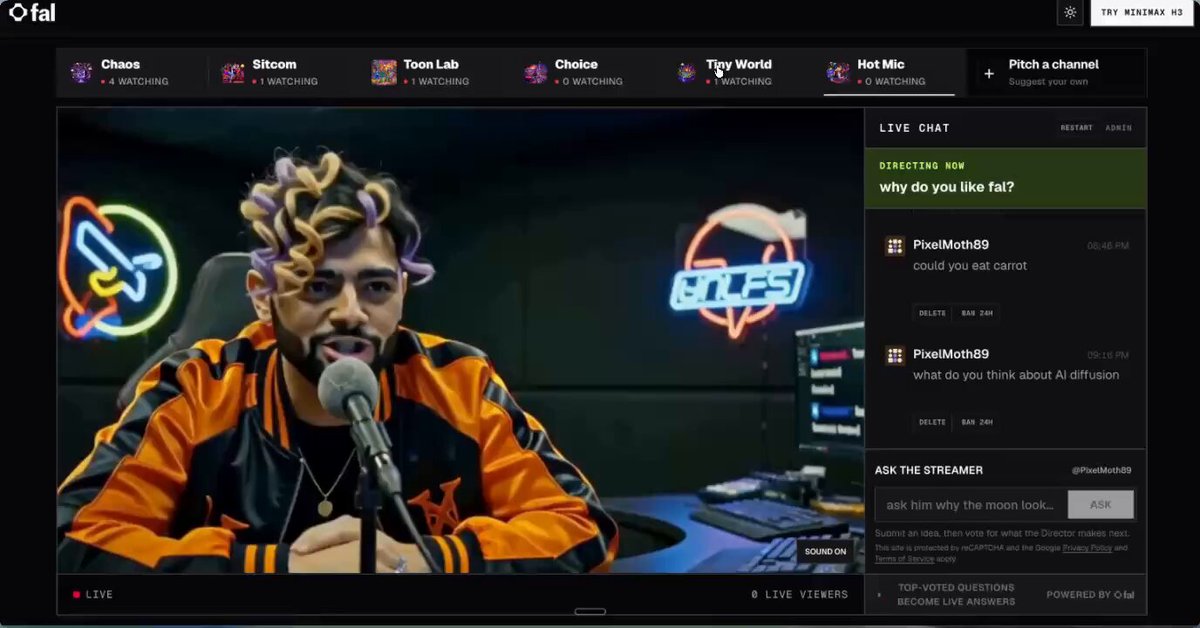
Fal launched live.fal.ai, a platform where audiences prompt what happens next in a continuously generating AI video stream. It runs on H3 Max Director, an autoregressive variant of MiniMax H3 Max with up to two minutes of context. The platform has already been paused for a quality upgrade, but what shipped was enough to confirm the architecture works.
Something genuinely strange happened on the internet on 31 August 2026. A video stream ran continuously, generated frame by frame in near real time, and the people watching it were also the ones writing what happened next. No pre-rendered segments, no branching menus, no hidden decision tree. Just a live prompt box, an audience, and a model producing footage as fast as viewers could type.
That was live.fal.ai, and it is already the most direct proof anyone has offered that continuous AI video generation is ready to carry an audience rather than just impress a demo crowd.
What Fal actually shipped
@fal described live.fal.ai as an experiment in infinite, interactive AI livestreams. The mechanic is simple: viewers pick a channel, prompt what happens next, and the platform generates it in real time. The framing Fal used was precise, "You aren't just watching the show. You're directing it." Within hours of launch, @Hailuo_AI posted footage of the same architecture being used for audience-directed narrative video, confirming that the interactive layer extended beyond a single controlled demo.
The engine underneath is H3 Max Director, which Fal describes as an autoregressive and natively continuous variant of MiniMax H3 Max. The critical specification is a context window of up to two minutes. That is long enough to hold a scene, sustain a character across an interaction, and preserve visual continuity while the next prompted segment is generated.
What this means in a real production context
For working AI filmmakers, the immediate relevance is not the livestream format itself. It is the confirmation that H3 Max can be run in a continuous autoregressive mode where prior context is fed back into each new generation. That is architecturally different from the generate-clip-stitch-clip workflow that most current AI video pipelines depend on.
In the current standard approach, a filmmaker generates a five-to-ten second clip, downloads it, trims it, and uses its last frame as the seed for the next generation. The seams are the problem: lighting drifts, character proportions shift, and the edit becomes the place where the illusion breaks. A model that can hold two minutes of context and generate forward from it does not eliminate those problems entirely, but it changes where they appear and how often.
The open question is latency. Live streaming requires generation to keep pace with real-time viewing. Whether H3 Max Director can sustain that at broadcast quality, for extended sessions, without degradation, is not answered by this experiment alone.
What was not said
Fal did not publish technical benchmarks for H3 Max Director, did not announce pricing for API access to the continuous mode, and did not confirm a relaunch date. The platform was paused the same day it launched. The announcement post said Fal is working on "the next level of quality and overall experience" before bringing it back, which suggests the live session revealed friction in the output quality under real audience load, which is exactly the kind of information you only get from shipping to users.
There is also no public confirmation of whether H3 Max Director is the same model as the standard H3 Max with a modified inference loop, or a separately trained variant. The distinction matters for anyone hoping to replicate the continuous mode via the existing H3 Max API.
What to test when it returns
The most useful thing an AI filmmaker can watch for when live.fal.ai relaunches is character drift over extended sessions. A two-minute context window is long enough that any instability in identity or visual style will become visible. Watch how the platform handles a character who is prompted to change location: does the face hold, does the costume remain consistent, does the lighting shift feel intentional or accidental?
The second thing to probe is prompt latency. If viewer prompts are queued and processed sequentially, the platform effectively becomes a slow-motion director's cut tool. If they are batched or merged, that creates a different dynamic where individual creative control is diluted by consensus. Understanding which mechanic Fal has chosen will tell you a great deal about how the underlying pipeline could be adapted for solo production work.
What Fal has demonstrated, even in a paused experiment, is that the infrastructure for viewer-directed AI narrative is functional today. For filmmakers thinking about interactive formats, that timeline just moved considerably closer.